It’s Only a Matter of When
I’ve been trying to square my lack of enthusiasm about the iPad with the seemingly very positive analyses from those smarter than me.
After a few days, I think I finally reconciled it with a simple realization: the only reason I’m not enthusiastic about the iPad as a consumer is that it simply falls below my value curve at this point in time. Consider the graph below:
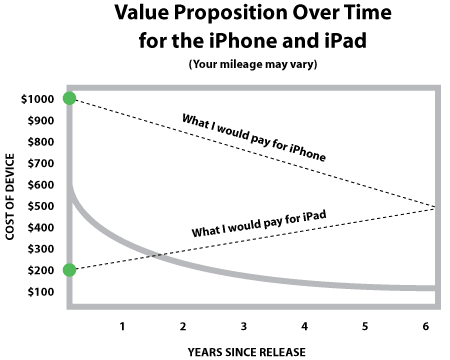
When the iPhone came out, I would have paid $1000 for it. I still would, to be honest. I wouldn’t exactly be happy about it, but I’d do it. It provides so much utility to me, it’s become such an indispensable part of my life, and it has no perfect substitutes, so its price elasticity to me is extremely low. Apple can charge pretty much whatever it wants and I will buy exactly one iPhone.
When the iPad was announced, however, the value curve was very different for me. It is currently a device I’d pay about $199 for. Not $499-$829. That is not to denigrate it at all. It just means its current value to me is below its current price. I don’t read eBooks, I have a laptop for my mobile computing needs, and I don’t have a place in my workflow for this device at this point in time.
The key is what happens over time, however.
The first effect is a pricing effect. As the price of both devices inevitably decreases, the value equation begins to change. A $10,000 iPad sells maybe 1000 units. A $1000 iPad sells maybe a million units. A $100 iPad sells 50 million units. And a $10 iPad sells about 500 million units.
So then, “liking” the iPad is really just a question of “what price would you pay for it?” For me, it’s about $199 right now. Electronic toy price, in other words. For others it may be a lot higher, and still others, lower.
The second effect is a utility effect. The utility of an iPhone is very high right now. It already plugs into existing cellular and wifi networks, it fits in your pocket, it replaces multiple devices, and it has few competitors. What happens when it’s not the only horse in the race though? We’re already starting to see stiff competition from Google with the Nexus One and Nokia undoubtedly wants to play this game too. It’s unclear whether any competitors will succeed making a better smartphone than Apple, but they will certainly create viable substitutes, thus reducing the unique utility of the device.
Look at what happens (possibly) with the iPad though. You can just sense by looking at it that it’s a bit “early”. There isn’t enough to do with it yet. The New York Times app looks nice and all, but it’s a far cry from a world of widely available, richly laid out e-publications (I personally question, however, if we even need this sort of world). You also can’t use the iPad for home automation stuff yet (although my buddy Danny will be working on it). You can’t beam Hulu from it to your TV. You can’t video conference with it. You can’t control it with voice commands. You can’t run it for a week on a single charge. These are all things I think we’ll see in the next several years, and thus it may become a more valuable device as time goes on.
When either the price is lowered to my value threshold, or my value threshold rises due to increased utility, that is when a purchase will be made. Perhaps even multiple purchases.
There is little doubt in my mind — upon finally thinking this through from a dispassionately microeconomic standpoint — that at least one of these two things will happen; and that is why Apple wins in the end, despite our best attempts to be curmudgeonly about it.
Never Dupe Your Readers
I normally stay out of the fray when somebody in our industry does something stupid — because it happens so often — but what Jason Calacanis did to his readers on Twitter last night and this morning is as clear an example of pomposity and disrespect as you’ll ever find:
Jason, with a good-sized Twitter following of over 90,000, began sending out tweets with details about Apple’s new tablet before it was officially announced this morning. He claimed to have been given one by Apple, for press purposes, and began reeling off details in separate tweets, such as:
You get the picture.
Several media outlets including TechCrunch, the Wall Street Journal, and thousands of individuals picked up Jason’s tweets and that’s how I found out about them (I don’t follow Jason). Upon inspecting the tweets, I immediately knew how this was going to end: badly. As someone who’s followed Apple closely for most of my life and also someone who doesn’t really give Jason Calacanis credit for much of anything besides incessantly promoting himself, I knew Apple would never give a guy like that a device in advance under any circumstances, for any reason.
Sadly, and predictably, however, Jason was able to fool thousands of others. He’ll be the first to try and convince you his tweets were too absurd to be construed by any reasonable person as true, but we’re not just talking about country bumpkins who were duped here. Look no further than Robert Scoble’s first comment in the comment thread on CrunchGear (or any of his comments on Twitter). He doesn’t appear to think it’s a silly joke upon first read. Neither did Neil McIntosh at the Wall Street Journal. And neither did many thousands of Jason’s “followers” throughout the world.
Let me see if I can make this as clear as possible:
Never dupe your readers.
Never dupe your readers.
For someone who seems so dead set on being a lot more influential than he actually is, it’s the height of irony that Jason would do something like this. The fact that it occurred only on Twitter and was a lot more believable than it could have been if it were really just an altruistic joke really tells us all we need to know about the motivations here. It went something like this:
- There’s a huge Apple event coming up and nothing stirs press like a huge Apple event.
- I have an ego, a Twitter account, and a company to promote (probably in that order) so I’ll post some fake, but borderline believable stuff and see what kind of linkage/followership I can get.
- If things get out of hand, I’ll make my tweets increasingly outlandish and just claim it’s all a big joke and anyone who believed it is an idiot.
Well, mission accomplished, I suppose.
This sort of thing makes me shake my head because I’ve seen it before and it just never turns out well… and it’s never forgotten. I remember a few years ago in our little corner of the tech industry — web design and development — two reasonably well known colleagues started a high-profile fight on their blogs, each accusing the other of “borrowing” various design elements and outright creative theft at times. It went on for a few blog posts and some of us began taking sides in the comment threads, trying to defend the good names of our friends. After a day or two, both people revealed that the whole thing was not real and meant to “illustrate a lesson” about creative license. As you can imagine, we were all pretty livid. Not even necessarily because it was a waste of our time or anything, but because we had been purposely duped by people we trust. It didn’t matter that the intentions were not evil. Nobody likes to be duped.
Which brings us back to our story about Jason and the ruse he pulled on his followers. I’ve felt this way for a few years now, but there are many people in our industry who think they are a lot more important than they really are. Some examples that come to mind are:
- The majority of tech writers. If you’re in the minority who are actually really good journalists, please don’t take offense to this statement. You’re doing a great job. But some of these “lifelong pundits” who’ve never created a damned product in their entire life and want to tell you their thoughts on “gestures” or “lifestreams” or “the future of {insert-overhyped-technology-here}”? Please consider writing in a diary instead.
- Relentless self-promoters. This is the group Jason fits into. I’ve only met Jason once, when I worked at ESPN and he worked at Weblogs, Inc. I posed a question to him on a panel about when Engadget would start to put more advertising on their site. He claimed never, which of course turned out not to be true. I respect Jason for one thing: selling Engadget to AOL. That’s a great accomplishment. That’s about it though. Everything else I know about him is based on what he puts out there for everyone to see: someone who loves the sound of his own voice, will say anything to get ink, and has very little regard for the truth.
- People who measure themselves by false metrics such as Twitter followers, Facebook friends, LinkedIn connections, or any other data that doesn’t actually measure the amount of good you’re bringing to the world.
If you want to be influential, lead by doing, not by talking, and certainly not by duping. If what you create is really good, other people will talk about it for you.
It’s perfectly ok to talk about your own product and do some promotion when appropriate, but what it’s never ok to do is dupe your readers. Don’t make the same mistake yourself. If you want respect, be respectful first.
Do You Want To Work At Newsvine?
I just opened up our first ever dedicated interactive design position this week. If you’re just a little bit crazy, you might be perfect for it.
The official way to apply is by sending an email to msnbcjobs@msnbc.com (which you should do if you’re interested), but if you’re a Mike Industries patron, feel free to contact me as well.
Msnbc.com Acquires EveryBlock… Welcome Brother!
News that has been brewing secretly for the last several months finally broke this morning: Msnbc.com has acquired EveryBlock, the most interesting (in my opinion) startup in the hyperlocal news space. It is with great joy that I welcome my colleagues Adrian Holovaty, Wilson Miner, and the rest of the EveryBlock crew to the msnbc.com family to help re-imagine, re-invent, and re-volutionize local news online. You can read several other accounts and descriptions of the acquisition here (msnbc.com, New York Times, EveryBlock, Lost Remote) but I thought I’d provide some color from the standpoint of a founder whose company, Newsvine, was acquired almost two years ago by the same company.
First let me say that the acquisition of EveryBlock is an excellent fit for both companies. Msnbc.com’s focus has always been on national news, a concentration that has made them the most visited news site in the United States for over a year now; more than CNN, more than Yahoo News, and more than most local news sites combined. Leading the national news race is a great accomplishment to anchor your company around, but local news is where most of the disruption is occurring these days, and thus it is fertile ground for innovation. Local newspapers find themselves rich with great journalism, but crippled by legacy distribution and operational costs. Community news blogs enjoy tremendous grassroots energy but very little means to monetize their content. There are a million gusts swirling around in the local news tornado right now, and when the dust finally settles, the landscape will be much different than anyone could have imagined even five years ago.
The organizations that succeed in local news will be the ones who respect all of the great journalism and increasingly available data in cities and neighborhoods across the world while creating better ways for people to consume it. If you’re a organization in the local news space — big or small — and you’d like to be a partner in this future, we’d love to work with you.
Another reason I’m excited to welcome EveryBlock into the family is that I think it’s a great family to join if you’re an entrepreneur. When we signed on with msnbc.com almost two years, it was a leap of faith considering that other suitors would have provided different experiences. We knew msnbc.com was the closest to us geographically, so that part couldn’t have been matched, but you never know how you’ll be respected, used, or abused until you’re part of the family. When I read about incredibly smart and likable people like Joshua Schachter selling a great service like Del.icio.us to Yahoo, only to see Yahoo marginalize the product and send Josh fleeing the company like a burning building, it saddens me.
In addition to things going horribly wrong between acquirers and entrepreneurs, a perhaps even more common case is when entrepreneurs leave on good terms the day their contract period is up. For background, when you sell your company, you are usually required to stick around for some period of time until you receive all of the acquisition proceeds. This happens all the time, the most recent of which (that I can recall) being Dick Costolo at Feedburner. Dick’s a great guy, he sold a great service in Feedburner to Google, but he left more or less when his contract was over. There’s nothing wrong with this all… he made a truckload of money and probably wants to blow some of it on gold chains and petrified walrus testicles.
I think when you’re an acquirer though, your real hope is that the employees you are welcoming into the family *want* to work for you after they no longer have to… and that is the situation we find ourselves in right now.
Things, for the most part, are going swimmingly. Although building technologies and services for msnbc.com has slowed our development efforts on newsvine.com a bit, for the time being, Newsvine now serves over 4 million uniques a month; almost four times the traffic we did, pre-acquisition. We’re also distributing more revenue to our great community of writers than ever before. Additionally, there has been some nice cross-media collaboration in the form of Newsvine members appearing on national television and gaining press access the political conventions in 2008. We also have people like Retired Colonel Jack Jacobs and NBC Correspondent Chuck Todd popping in to write articles and answer questions during important events. All of this and we feel like we haven’t even scratched the surface yet.
There’s plenty of unfinished business to do when it comes to building out the Newsvine, msnbc.com, and now EveryBlock communities, and we’re just thrilled to be around to do it. I look forward to working closely with the EveryBlock team in the coming months and welcoming another passionate group of people into the company.
Breaking Ground
344 days ago, I bought my first house. Today, I began demolishing it. You can view the live cam of the progress on the newly installed House by the Park Live Cam here.

Before: A charm-free 1953 house that’s never been updated, on a great plot of land.

After: A rendering of what the new Northwest Modern house will look like.
It’s been a long but fun road getting to this point, and both my design/build firm — Build LLC — and I are extremely happy to be breaking ground. Throughout the design and construction process, I’ve kept Mike Industries mostly free of updates, instead opting to chronicle everything on A House by the Park. After all, I don’t want to stray from this blog’s laser focus on web design, remixed infomercials, and tasty beverages. So far, it seems that decision has been a good one, as Mike Industries averages about 10,000 RSS subscribers while HBP has only 547. It is not surprising that most people are uninterested the ins and outs of homebuilding.
That said, the design and construction process — and the in-situ documenting of it — has been extremely educational to me and I want to share a little of what I’ve learned so far:
The site itself: A House by the Park
I am not building the best home in the world and I am not the greatest writer in the world, but I honestly believe that HBP is the most complete and useful first-hand journal of custom homebuilding online today. There are updates on every aspect of the process, from finding the property, to negotiating, to choosing an architect, to homing in on a design, to the difference between a G.C. and a C.M. Every step of the process is in there, with costs attached. The cost thing is a bit controversial and several people have asked me why I’m exposing how much I pay for everything. The answer is simple: costs are the murkiest aspect of design and construction and if I’m going to demystify the process of building a home, it is essential to expose them. There is no sense in detailing interesting things for other perspective home builders only to leave them in the dark about what something similar might cost them. This blog is about transparency, and everything I can reveal, I will reveal.
HBP is also a great marketing tool for people and businesses involved in my project who do a great job. I plug Build all the time because they deserve it, and I also mention and/or link to contractors, consultants, and others who help along the way.
The economy
When the economy dropped off a cliff last October — right in the middle of design stage — I wavered as to whether or not I wanted to go through with construction. While mostly (but not completely) out of the market at the time, a sinking feeling that the U.S. financial system was about to implode got me briefly curled up in a ball like the rest of the country. I contemplated delaying the project until the economy recovered (if it ever recovered) both for my own mental well-being and because with real estate values plummeting, it seemed like a bad time to be investing more in real estate.
I jumped back and forth between wanting to build and wanting to delay, but in the end, what got me over the hump were a few things:
- This is the house I want to die in. I never want to sell it, so its paper value means less to me than its intrinsic value. This fact lessens my interest in turning any sort of profit and heightens my interest in getting it done as quickly as possible so my girlfriend and I can enjoy it before we are old and decrepit.
- The best time to build is when everyone’s business is slowing dramatically. If you build on the upswing, contractors’ bids and availability reflect the fact that they are in high demand. If you build at the bottom, many contractors and subs have already gone out of business so the labor pool has shrunk to match demand. But if you build on the downswing, the available pool of contractors is gigantic and the rates are lower as a result. So far, we are getting extremely competitive bids… a rarity in recent times, I hear.
- I feel a certain patriotic pride that I am helping put people to work at a time when our economy needs it most. My architects told me I’m one of the few who have “gotten out from under the covers” and I feel good about that. I feel we overspend quite a bit as a nation, and I don’t think people should just go out there and spend willy-nilly to stimulate the economy, but if you have the means to make a purchase right now, whether house, car, education, or other things, there’s never been a better time to do it.
The people
The number one thing that will determine whether or not a home building project is a success is what group of people you choose to work with. You can hire the greatest architect in the world, but if you aren’t on the same wavelength as him or her, your project will turn out horribly. Similarly, even if you make it through design stage with flying colors, the wrong contractor can bring the project in well above your budget level. When I interviewed two general contractors before moving forward with Build as my construction manager, one of them provided me with a “low estimate” and a “high estimate” to account for if things went well or poorly. Their low estimate was almost twice the total cost of the project when going the design/build route, and the high estimate was almost three times! An uninformed client would be out several hundred thousand dollars or more with the wrong decision there.
So far I have not hired a single person on this project that I regret hiring. Everyone’s been great and that has contributed to an ultra-low stress level for me.
Cost structures
I am procuring flat fee bids for every service I possibly can. Build charged me a flat fee for design and a flat fee for construction management. The electrical, plumbing, framing, and other bids are all flat bids as well. As a client, I love the flat fee system because I know exactly what I’m getting and I know exactly how much I’m paying for it. I don’t care if it takes someone longer or shorter than they estimated. I just want the work done and I want to pay a certain amount. As a designer, I also prefer this system. If someone wants a logo designed, I’d rather charge $5000 up front and agree to spend as much time as it takes to get the job done. If I kick ass and produce a great logo in a few hours, woohoo for me. If it takes me longer than expected, my effective hourly rate just decreases a bit. Not a big deal.
Anyone who agrees to pay an architect 15% of the cost of construction should think twice about how their interests are aligned. If the architect makes an extra 15% if he or she convinces you to use a material that is more expensive but not that much better than another material, how is that good for you? I’m not implying any sort of dishonesty here… just misalignment of interests. If I charged that way, I would also naturally gravitate towards the most expensive items my clients could afford.
I have a huge amount of respect for the fields of architecture and construction. I just want to be charged in a way that aligns my interests with my providers’.
Being green
The easiest way to “be green” is to live in a windowless, heavily-insulated, unlit, underground bunker. You’ll barely suck any energy from the grid and you can brag to your friends at parties that you have less of an impact on global warming than Ed Begley Jr. Of course if you do this, you will eventually complete your transformation into the Unabomber and not be allowed at parties — let alone in society — anymore.
The best way to think about building green is to figure out how to have as little of a negative impact on the earth as possible, whilst maintaining the reasonable level of comfort that an atmospheric parasite such as yourself is accustomed to. Does this mean giving up your beautiful west facing view for the sake of completely eliminating solar gain? No. But it means making other smart decisions along the way.
For me personally, it meant donating nearly 55 tons of material such as sandstone and teak to The Re-Store so it can be re-sold instead of shoved into a landfill. It also meant building a smaller, better insulated house than what is currently on the property. And finally, it meant not blowing $100k on environmentally questionable photovoltaic panels or drilling into my hillside for geo-thermal energy, but pre-wiring my roof for 5 or 10 years from now when we can unroll solar panels like beach blankets.
Tumbling as window shopping
I created a Tumblr at tumblelog.ahousebythepark.com to clip all of the interesting things I see on the web which may work well in the house. From appliances, to siding materials, to furniture, it’s a great place to store stuff you want to remember later. No more “where did I see that cool lamp?”. It’s all on the Tumblr. My architects can also monitor the Tumblr to get a feel for what sorts of things interest me and what they may have to design for along the way.
Onward…
Almost a year after beginning phase one, we now move onto phase two: construction. Phase one may be the make or break phase for curb appeal, but phase two is where bank accounts go to die. I don’t expect more than a small percentage of Mike Industries visitors to follow along, but if you’re interested, head on over to HBP and help shape decisions along the way.
We now return you to your regularly scheduled programming.
Last Rites

Last week was a sad week to be in the Newsvine offices. While we were toiling away, our friends upstairs at the Seattle Post-Intelligencer received their unemployment orientation in advance of being laid off two weeks from now. The conference room in which these talks occurred is right next to Newsvine headquarters, so during the course of entering and leaving the office throughout the week, I caught multiple glances of the scene and the people affected by it.
People losing their jobs is always a sad thing but I feel like this is the true beginning of the end for almost everyone who works at a newspaper. If you work at one and you aren’t intimately tied to the web operation, you should start making future plans as soon as possible. And honestly, even if you are intimately tied to the web operation, I wouldn’t feel too safe either.
The death of the newspaper is a depressing thing to absorb, but what’s much more disappointing to me is that I feel like news itself has been devalued. There’s an oversupply of news-“ish” information on the web, and people have decided — usually without realizing it — that free “news snacking” is a better value proposition than paying for in-depth reporting. As one who is surrounded by news snacks everyday in the form of Newsvine, RSS feeds, instant messages, and other inputs, I’m as guilty as anyone of this mentality. At the end of the day, I just feel like through my various short-attention-span news inputs, I will absorb most of the news zeitgeist without any cost to me.
Cost is a funny word though. It is generally used as it was used in the paragraph above: to denote the expending of money. Lately though, I’ve noticed there are many non-obvious costs associated with us becoming a society of news snackers:
- Our attention spans are shrinking below even the levels caused by the television explosion of the ’80s and ’90s
- We are consuming more and producing less (no, sharing or reblogging does not count as producing)
- We value timeliness of information more than depth of coverage, or even truth in some cases
- We are driving most kids completely away from journalism as a profession
- We’re uncovering more of the whos, whats, whens, and wheres, but less of the hows and whys
I suppose we’re saving some trees and removing some friction from the publishing flow in the process, but all of the above are very bad things; things that will probably take us awhile to fully realize the effects of.
A lot of people have been asking me lately how the P-I (and newspapers in general) could be saved and even whether I’d like to be a part of it. In fact, if you want to see a live session about it and you live in Seattle, I’ll be doing an event at the UW Business School on the subject next month.
I have several modest ideas but none of them involve saving the actual paper. I’m a lot more interested in saving the future of long-form and local reporting than I am in saving the newspapers themselves.
Rarely are one’s ideas completely original so I’m sure these are no exception, but here are the three most promising in my opinion:
Getting smaller and staying local
Many privately held businesses and all publicly held ones require growth. It isn’t enough to turn a healthy profit every year. If your business isn’t growing, your management is questioned and your stock declines. The first step in keeping local news viable is realizing that it may not be much of a growth business, and it may be quite a bit smaller of a business than it has been in the past. These two factors do not bode well for the prospects of publicly held local news companies in the future. Imagine the P-I as something more along the lines of what Cory Bergman has built with his network of neighborhood blogs like My Ballard. I would argue a fully built-out neighborhood blog network like this is more valuable than what the P-I currently has. Nothing against the P-I’s website… it’s great… but it doesn’t pull me in as a citizen of my neighborhood. It’s a conventional mix of local stories that usually aren’t that local to me along with national stories I prefer to read on sites like msnbc.com instead.
Local news companies need to concentrate on creating communities of people who talk to each other, not just people who read the news and leave. Where you can connect people, you can make money.
Make something that’s worth paying for again
I may not pay for every author I happen to read on a daily basis, but there exists a collection of more than a few people on my blogroll who I would pay $5 a month to read, if it were exclusive. I’ve always been bearish on paid content as a model, mainly because you could usually do better with advertising, but with CPMs dropping through the floor, I’m not convinced that is necessarily the case anymore. What I’d like to see attempted is positioning a publication as more of a “discussion club”. Heck, maybe you even can read the content for free, but in order to join the discussion, you need to be a paid club member. With membership also comes social events around town, swanky garb, and other niceties to help you rationalize your modest membership fee. I always thought the New York Times should have done this with Times Select.
Bear in mind, I’m not suggesting just throwing up a pay wall. That would not work. The idea is creating bits of value — in addition to content — that people would gladly pay several bucks a month for.
Partner with your people
As a great business, your customers should be your best partners. In the case of news agencies, this doesn’t need to stop at readers evangelizing your publication for you. In many cases, they are actually willing to help you run it. Why have a staff of 150 when you can have a staff of 15 and engage your community to help produce a lot of the content? People like doing things that benefit their community. Make sure your business is seen as a way to do that.
The future of journalism may be in pro-am publishing.
Anyway…
Overall, I’m not super optimistic about the future of a lot of these newspaper companies, but I really would love to see them at least replaced with something better. I still have a hard time believing that a 146-year-old company like the Seattle P-I is moving out of their own building before we are. I don’t see that as any sort of victory for Newsvine since we are much more of a news platform than a news agency, but rather an indication of what happens when you have everything to gain and nothing to lose versus everything to lose and nothing to gain.
Goodbye Bloglines…

The Bloglines Plumber. Poor guy. He was recently even replaced with balloons.
I wished this day would never come but have suspected for the last couple of years that it probably would. This weekend, I officially said goodbye to the website that changed the way I consume information more than any other site I’ve ever used: Bloglines.
I started using Bloglines in 2003 when it was the only viable web-based RSS Reader and before most people even knew what RSS was. It instantly changed my information consumption routine from pull to push. The thoughtfully designed interface and reliable uptime allowed me, and thousands of others, to quickly and efficiently sift through a lot of information in a short amount of time.
When Ask.com purchased the company from Mark Fletcher in 2005, I applauded the acquisition and just hoped the new company would more or less leave things they way they were. Unfortunately, over the last few years, uptime has gotten progressively worse and there haven’t really been any great features launched to offset the decline in reliability. Sure there’s a Bloglines Beta that’s been out for over a year now, but I don’t even like it as much as Bloglines Classic.
I don’t even mind the planned and unplanned downtime Bloglines occasionally sees. That’s fine. What I mind is that Bloglines has seemingly entered the late stages of Alzheimer’s over the last few months. Often I will read an item only to be reminded once, twice, or ten times in the future that that item is still “unread”. Or, all of the unread counts will rocket up to 200 and then back down a few minutes later.
When software starts to increasingly work against you, it’s time to change software, and so finally, I made the switch to Google Reader this weekend. I applaud Ben Lowery, Eric Engleman, and the Bloglines Team for all of the hard work they’ve put it over the last few years and I realize they are probably swimming against violent tides, but it’s just time to move on.
So far, I’ve found Google Reader to be much more reliable — which is no shock — but I’ve also found some niceties in the interface that I wasn’t expecting. One of the reasons I didn’t switch earlier was that I like Bloglines’ style of marking everything as read as soon as I click a feed and then allowing me to mark all as unread easily if I need to. I also like how Bloglines’ allows you to permanently save items on a feed-by-feed basis and separate them from the actual new items (Google makes you just “Star” them and they go into the big pile of Starred items).
I have to admit, I was extremely skeptical of Google Reader’s option of marking items as read as they pass through the browser’s viewport, but if you confine yourself to scrolling with the space bar, it actually works beautifully. In fact, I would go so far as to say the spacebar is Google Reader’s “killer key”. It just makes everything work better.
Another nice feature is the ability to view all items in a feed you’ve maybe just subscribed to and then quickly spacebar through everything. Google Reader only loads a few of the items and then as you get further down the list, it automatically loads more. Seamless. Great for feeds like Momoy which are image-heavy and text-light.
Finally, Google Reader’s mobile interface is spectacular on the iPhone. It’s really a joy to use.
So anyway, farewell Bloglines. You’re still my favorite website ever. Just not right now.
How the Financial Collapse Actually Occurred
If you want to get really educated and infuriated about the current economic crisis, read this lengthy, entertaining, and highly disturbing piece by Michael Lewis on Portfolio.com. Thanks to kottke for the link.
The article is without a doubt, the best rundown of the hows and whys of almost everything about the crisis that I’ve read (this animated primer not withstanding). Just when you think you understand everything, you read something like this and realize how many layers of misdirection are between average investors and their investments. The key paragraph of the article to me was the explanation of how more bets were made on mortgages than the amount of mortgages that even existed (!):
Whatever rising anger Eisman felt was offset by the man’s genial disposition. Not only did he not mind that Eisman took a dim view of his C.D.O.’s; he saw it as a basis for friendship. “Then he said something that blew my mind,” Eisman tells me. “He says, ‘I love guys like you who short my market. Without you, I don’t have anything to buy.'”
That’s when Eisman finally got it. Here he’d been making these side bets with Goldman Sachs and Deutsche Bank on the fate of the BBB tranche without fully understanding why those firms were so eager to make the bets. Now he saw. There weren’t enough Americans with shitty credit taking out loans to satisfy investors’ appetite for the end product. The firms used Eisman’s bet to synthesize more of them. Here, then, was the difference between fantasy finance and fantasy football: When a fantasy player drafts Peyton Manning, he doesn’t create a second Peyton Manning to inflate the league’s stats. But when Eisman bought a credit-default swap, he enabled Deutsche Bank to create another bond identical in every respect but one to the original. The only difference was that there was no actual homebuyer or borrower. The only assets backing the bonds were the side bets Eisman and others made with firms like Goldman Sachs. Eisman, in effect, was paying to Goldman the interest on a subprime mortgage. In fact, there was no mortgage at all. “They weren’t satisfied getting lots of unqualified borrowers to borrow money to buy a house they couldn’t afford,” Eisman says. “They were creating them out of whole cloth. One hundred times over! That’s why the losses are so much greater than the loans. But that’s when I realized they needed us to keep the machine running. I was like, This is allowed?”
The article gives more context and clarity around that, obviously, but it’s shocking enough on its face.
On a related subject, another thing that’s been irking me lately is this notion that’s been appearing on CNBC a lot lately that “buy and hold is officially dead”. What a stupid thing for anyone who knows anything about investing to say. Investing is almost by definition buy and hold. Trading is something entirely different. The notion that people won’t be able to buy stocks in companies they believe in and ride them up over the long term anymore is ridiculous. These people point to charts and say things like “if you held onto X stock from 10 years ago until now, you’d be down 10%”, as if this latest huge crash was just another normal, expected event. Nevermind that before the crash, they would have been up big. Corrections are supposed to happen, but crashes like this are the result of things that should never happen. Things from the above article. The perfect storm of manipulations to the system that should have been illegal and will never be seen again.
Sure, we’ll have more manipulators working on different ways to get ahead of the system in the future, but I don’t think something this big will be seen again in our lifetime. That in mind, buy and hold (with proper asset allocation) would still seem to be not just the best investment strategy, but really, the only one. Anything less is just gambling. And if there’s anything we need to see less of in the economy right now, it’s gambling.
14%
Of all the interesting (and troubling) things that have come to light as a result of the recent financial crisis, one of the most interesting — to me at least — came tonight: Chuck Todd appeared on NBC Nightly News with some data he ran on today’s bailout vote. It turns out most of those who voted “yes” to the bailout aren’t involved in close re-election campaigns (or haven’t been in the past) and most that voted “no” are (or have been).
So essentially, representatives that are scared about their re-election prospects voted no and representatives that aren’t voted yes. No numerical breakdowns were given, but that was the overview.
This is troubling on a number of fronts:
- It shows that our politicians are reacting to a bona fide crisis not on the merits of the crisis but rather on the circumstances of their re-election. This happens a lot, of course, but during a potentially devastating crisis, it’s troubling.
- It shows that what a lot of people think is the “smart” thing to do (passing the bailout), is not the “popular” thing to do. If you believe that your representative should do what you want them to do, the numbers say this bill should not pass (over 50% of Americans think it’s bad). If, however, you think that representatives should do what *they* think is best for you, it should probably pass (most representatives seem to think it’s needed, regardless of how they voted today).
- It shows that politics have absolutely become part of a situation that needs to be solved jointly by both parties.
- It shows that many members of Congress as well as many Americans don’t actually understand what this plan is designed to prevent and who it benefits. It may not be a perfect plan, but it’s not designed to “bail out Wall Street fat cats”. It may not punish Wall Street CEOs like many people would prefer it to, but if you want to do that, do it with a lawsuit.
I can only hope that the failure of the bill eventually just causes us to pass a better bill later this week, but you have to wonder a bit when George W. Bush, Barack Obama, John McCain, and the controlling party in the House all agree on something and Congress still won’t pass it. It’s no wonder why only 14% of Americans approve of the job they are doing.
(Side note: That Gallup site is a pretty spectacular destination for information. Great graphs and polls, updated daily.)
It’s Always Sunny In Philadelphia
This strikes me as the dumbest idea I’ve ever heard out of the news industry. Protect a product on the decline by making a product on the rise intentionally worse?
Mmmmkay.
Why not just shut your website down entirely so that the only way to get Inquirer content is by paying for a paper to be produced and delivered to you?