A Rookie Guide to Digital SLR Cameras
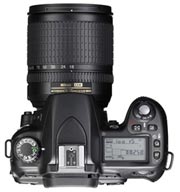 There comes a time in every point-and-shooter’s life when he or she wonders if there is more to photography than a palm-sized block of aluminum stowed away in one’s pocket. The ultracompact point-and-shoot has come so far in the last ten years that it’s tempting to write off DSLRs as largely irrelevant to most people’s lives, not offering enough utility to offset their bulky presence and hefty price tag. As soon as I bought my first truly great ultracompact a few years ago, the Casio EX-Z750, I was in this boat. 7.2 megapixels in your pocket… what more could one possibly need? After eventually moving up to the excellent 7x zoom Casio EX-V8, I told myself I would never need a DSLR.
But then I tried one for the first one, on loan from the fine folks at Nikon. A Nikon D80. Seemingly the “it” camera for the last couple of years. This article will not so much be a review of the D80, but rather a guide for DSLR virgins considering purchasing their first full sized digital camera.
First and foremost, will you use it?
We all love toys. We all love expensive toys. But nobody loves an expensive toy they never use. If you think you’re going to buy a DSLR and carry it around everywhere with you, you’re probably wrong. It’s heavy around your neck, it’s easily lost or stolen if you put it down in a public place, and it will never blend into the fabric of your life like a pocket camera will. In other words, be prepared to take it with you when you know you will be using it (e.g. sightseeing, stormwatching, portrait-taking, etc), but at all other times, it will probably stay at home. For this reason, even after you buy a DSLR, it’s probably good to keep your ultracompact point-and-shoot as your standard carry-along camera. Even on vacations, there will be plenty of times when the smaller camera is the only one on you at any given time. Again, I recommend the Casio EX-V8 as a fantastic ultracompact choice here. For the last few years, Casio has made the best all-around point-and-shoots, in my opinion.

Sunset at the top of Mauna Kea, 13,796 feet above sea-level. The highest peak above the ocean floor in the world. Definitely DSLR territory.
Nikon vs. Canon vs. everyone else
Most serious photographers will tell you there are only two real choices in the DSLR market: Nikon and Canon. Although companies like Olympus and Sony also make DSLRs, Nikon and Canon have such strong legacies in SLR photography that they’ve earned an unshakable amount of trust among professional photographers. Being an amateur, I am not one to question the conventional wisdom of professionals, so as far as I’m concerned, either Nikon or Canon should be your choice (for now, at least). The Nikon/Canon religious wars are less like the Mac/PC wars and more like BMW/Mercedes wars. With Macs and PCs, your Mac people think that PCs are horrendous piles of garbage and your PC people think Macs are overpriced, niche devices. BMW and Mercedes, on the other hand, really only differ in style… much like Nikons and Canons. They are equally priced, equally equipped, and even take cues off each other in the feature department.
For a good overview of the differences between Canons and Nikons, check out this article. My favorite quote:
“Canons are the best cameras available designed by engineers, and Nikons are the best cameras one can buy designed by photographers.”
That probably explains why I like this Nikon so much.
It’s the lens, stupid
Bodies come and go, but lenses are forever. So goes the saying. It may surprise you to know that some photographers are using the exact same lenses they were using 40 years ago. Even a brand new $5000 Nikon D3 can use a lens from the 1960s, if the photographer so chooses. These days, camera bodies and image sensors are evolving a lot faster than lenses, so to a large extent, it makes sense to invest more heavily in your lens(es) than in your cameras. Any photographer will tell you that they’d rather shoot with a cheap body and a great lens than the opposite.
There are essentially three things to consider when looking at lenses: speed, versatility, and stabilization.
Speed
Speed refers to how much light a lens lets in. If you’re like me, you hate flash photography and what it does to faces and objects, so you prefer to use natural light at all times. The only lenses that will let you achieve this are very fast lenses, usually with f-stops of 1.8 or lower. You can take a lens like this to a party at night and shoot beautiful naturally-lit shots even in the dimmest of corners (where you will probably be hanging out, since no one wants to stand with the dork carrying an SLR).
As a beginning photographer, your best option here is something John Gruber and Jim Ray (and millions of others) call “the best deal in photography”: the 1.8f 50mm prime lens. It’s small, light, fast, and just a little over $100. It is probably the only lens you will ever use after the sun goes down, and it also has an incredible narrow depth of field which is great keeping subjects in focus and backgrounds soft.
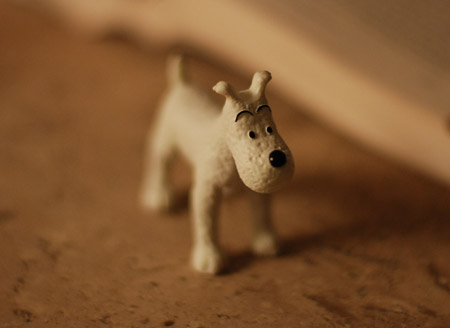
Tintin’s dog Snowy. This figurine is only a couple of inches long, and while his face is in focus, even his front paws are not. Narrow depth of field is a huge selling point of the 50mm prime lens.
Versatility
Although the 50mm prime has great light versatility, its fixed focal length won’t let you do any zooming, and thus, you may find yourself too far away at times to capture your ideal shot. Stalkers are well aware of this conundrum. In order to adequately frame subjects which are far away, you’ll need to pick yourself up a quality zoom lens. Even among zoom lenses, there is a wide range of versatility. There are 12-24mm (very wide angle), 70-300mm (very magnified), everything in-between, and even some further down and further out.
The first aftermarket lens I bought for my D80 was a Sigma 70-300mm, thinking it would come in handy for general use. More zooming would equal less walking and greater detail, or so I thought. In reality, it was a lens I found very little use for. Its inability to take “normal” wide angle shots, combined with the fact that at 300mm it takes a tripod to keep it from shaking, made it almost useless to me. I ended up trading it straight across for a Nikon 1.4f 50mm prime lens on Craigslist, which is much more useful to me (see above section on “speed”).
The most versatile lens in the world — and the one I eventually purchased — appears to be the Nikon 18-200mm VR lens. I bought this lens on recommendation from the great Ken Rockwell, and I couldn’t be happier with it. It does wide-angle shots at 18mm. It does telephoto shots at 200mm. Its focal length essentially covers you in 99% of the situations you’ll ever find yourself in. And it has VR, which I’ll discuss in the next subsection.
A lot of people have called the Nikon 18-200mm VR the most useful lens ever designed, and it’s not hard to see why. While professional photographers are used to carrying around a bag full of lenses, prosumers and weekenders would rather never have to change a lens. With the 18-200mm VR, you just pop the thing on and then forget about it. It’s a bit steep at $700, but worth it, in my opinion.
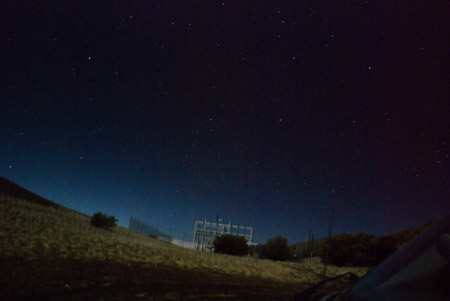
This picture was also taken atop Mauna Kea but under only the light of the moon. This is a 30 second exposure at ISO 1600.
Image stabilization
Both Nikon and Canon have image stabilization built into some of their best lenses now. I haven’t tested Canon’s out but it’s widely believed to be on par with Nikon’s VR (vibration reduction) technology. In a nutshell, VR is exactly what you probably think it is: a mechanism inside the lens detects camera shake and moves lens parts around in order to neutralize it. Does it work? It absolutely does. Is it noticeable? It absolutely is. I took some test shots around dusk, in low light, both with VR on and off and the difference is dramatic. The shots with VR off are blurry and unusable. Everybody’s hands have a different amount of shake to them, but most people report the ability to shoot about 4 stops faster when using VR. That is to say, if you can normally shoot handheld at 1/100, you should now be able to shoot at 1/15 (in much darker conditions).
As of today, Canon doesn’t appear to have an answer to the 18-200mm VR lens, but perhaps the closest thing they have is the Canon EF 28-300mm f/3.5-5.6L IS USM, but it’s about $2300. It goes up to 300mm which is nice, but the Nikon goes down to 18mm, which is more useful in my mind.

This photo was taken at 1/8 exposure and *no* VR. Blurry.

This photo was taken at 1/8 exposure *with* VR. Sharp!
Storage
The D80 uses an SD slot for storage, which I like, but some people prefer Compact Flash instead. Other models offer the use of either storage technology, sometimes in tandem. Pick whichever format suits you best, but with the cost of both Compact Flash and SD cards halving every several months, this may not be a huge factor in your purchasing decision. As of today, an 8 gig SD card can be had for $33.99 while an 8 gig CF card is about $39 so price per gig is roughly equivalent.
The megapixel myth
Image data is only as good as the source that captured it. In a DSLR camera, that includes both the lens and the image sensor. We’ve already covered the importance of the lens, but what about the sensor? Is a 6 megapixel sensor going to produce better photos than a 10 megapixel sensor? Currently, in most cases the answer is no. For most consumer/prosumer level DSLRs, the compact size of the sensor is such that megapixel levels above 6 do not increase the quality of the resulting image whatsoever. Edit (thanks Patrick): The answer is, “not always”. The size and sensitivity of the sensor is more important than the raw number of megapixels it produces so beware of judging cameras, even DSLRs, on their megapixel counts.
If you’re really interested in fully maximizing resolution and clarity, your only real choices are the new Nikon or Canon “full-frame” DSLRs. These cameras are all between $2000 and $8000 for the body only and have sensors which are much larger than any prosumer/consumer cameras. If you’re in the market for one, you’re probably way overqualified for this article.

High-resolution fire.
Interface and usability
Both Nikon and Canon have spent years refining their user interfaces, and users of each tend to prefer their own brand. My experience with Nikon was that I spent about 45 minutes reading the manual front-to-back (a rarity for me), then spent a couple of hours pushing buttons and turning dials, and I quickly felt pretty comfortable with the D80. Moving from the one-dial-one-button world of a Casio ultracompact to a 100-control DSLR still takes some adjusting, but as with most Apple products, the dials and buttons on the D80 seem to be designed very thoughtfully and generally serve their purpose while staying out of your way.
Filters
Most the time, the only filter you’ll ever need is a circular polarizer. Polarizers bend light as they enter the lens to either reduce or enhance reflections in the scene. They are particularly useful for reducing reflections off of water, snow, and buildings, and for creating more dramatic looking skies. Polarizers range from about 10 bucks to several hundred bucks, but most of the reading I’ve done suggests that a $40 polarizer is imperceptibly equivalent to the much more expensive ones. I use a Hoya that I bought for about $40 at Tall’s Camera.
What’s missing
In my mind, there are only three things missing from most cameras today, all of which I think will become standard equipment within a couple of years: GPS, wifi, and native HDR handling. GPS seems like a no-brainer and frankly I’m surprised it’s not more widespread already, considering how small GPS chips have gotten and the fact that a lot of phones have this capability already. Once all of my photos are automatically geotagged, it will become more interesting to collect and view them, and thus, I will take more of them. Wifi support is important to me because I’m often too lazy to transfer my photos to my hard drive or upload them online. Thankfully, a few months ago, the EyeFi was released, so that’s probably good enough, but it would be even nicer if it was built into the camera itself. HDR, or “high dynamic range” photography, is a method of photography whereby multiple shots at different exposures are composited together to produce dramatic, often surreal imagery. Some examples are here, in the Flickr HDR pool. It seems to me that a camera should theoretically be able to open the shutter once and take multiple shots from that, each during different points in the exposure, thus producing the layers necessary for the compositing.
Final analysis
So before you go out and buy a DSLR, here are some recommendations:
- Make sure you want one and have reasonable expectations for its usage
- Keep your ultracompact for everyday use, or buy a new Casio EX-V8
- When looking at DSLRs, trust what the pros use: Nikons and Canons
- Invest more in lenses than in bodies, disregarding any “resolution advantages” that aren’t also accompanied by larger sensors
- Purchase both a zoom lens for versatility and a fast prime lens for low light and narrow depth of field
If I was starting from scratch, here’s what I’d buy (List updated, from reader input):
- Nikon D80/D40x camera: $760/$545 (Go with the D40x if you’re price conscious, but know that it will not autofocus with some older lenses or even some inexpensive ones like the must-have 50mm 1.8f prime below)
- Nikon 50mm 1.8f lens: $105
- Nikon 18-200mm VR lens: $700
- Hoya Circular Polarizer: $30
- Total cost: About $1595 (D80) or $1380 (D40x)
If you’re just getting started with DSLRs, hopefully you’ve found this useful.
One small addition: buy a fast and reliable card. 133x/150x. One of these days, you’re going to want to shoot a burst sequence and find yourself hitting a wall after a dozen or so frames. I’ve had great luck with Lexar—4GB SDHC 133x runs around $78. It’s the difference between 2MB/sec and 20MB/sec, which is a big difference.
Cheers, Mike.
This is really good advice, even if a lot of people disagree about Ken Rockwell’s greatness. Also, a second hand D50 or D70 is well worth looking into for less than the D40x. Finally, if you’re going to have a compact digital for everyday shooting then it might be worth looking into a second hand 35mm or medium format film camera for more creative stuff.
Bradley: Yep, I’ve always gone super cheap on the memory cards, but sure, I can see where faster ones would definitely be of use during bursting.
Chris: Yep, I wouldn’t be afraid to go second-hand on a body. I feel like whatever body I own today is not the same body I will own in a few years. As for Rockwell, “great” may be a bit strong, but I’ve always liked the guy. I don’t necessarily like him because I think he’s the most *creative* photographer (in fact, he may be below average in that regard compared to most name brand photographers), but rather because he has a no nonsense outlook on gear. He has a focus on value, ease-of-use, and practicality, all of which are important to me because I’m never going to put in enough time to be a real master in this art.
on the issue of resolution over 6 megapixels, it has to be noted though that the article you link to refers to compact cameras (which have technically inferior and smaller sensors, even compared to non-full-frame lower-end DSLRs).
(Editor’s Note: Thanks Patrick. You’re right! Edited…)
Most DSLRs indeed offer exposure bracketing, which is all you need to combine shots into an HDR image.
Great primer Mike, but allow me to add my spin to a few points.
On Nikon vs. Canon, D80 vs D40x, any body vs another:
Too little is mentioned about ergonomics in feature reviews. Best advice to anyone is to find a camera store and handle all the cameras you’re thinking of. If i didn’t have the luxury of doing this I may have made the wrong choice [was one of the reasons I settled on the D80… I could have stretched for the next step up but that would have been bigger then I’d want to carry regularly — and if I don’t want to carry it, I’d end up deciding not to. Likewise, the D40 [which wasn’t around when i made my purchase] feels too small to me.
On Lens choice:
The 18-200 is great for someone that fears changing lenses or travels a LOT and wants to cut weight, but not everyone should jump out and pay the premium for that. There are other options worth looking at – I prefer the nikon 70-300VR and then something on the wider end, and a bit faster [50mm 1.8 or Sigma 30mm 1.4 kinda thing] [you don’t have to cover ever single ‘mm’. Price ends up being similar because of the premium on the 18-200mm, but in terms of mobility, when I don’t need the longer reach i actually end up being more mobile because I can feel comfortable leaving the 70-300 behind. As I said, there are really infinite choices here, and lie the body ergonomics its a matter of what fits your shooting style and budget [and if you don’t quite know yet *I’d* hesitate to suggest dropping $800 on one lens]
On GPS:
I use a little Sony gadget for this [GPS-CS1] – runs about $100 and you link your photos to the recorded GPS tracks after you shoot and are back to your computer. With the right software you can do this with any GPS device that you can get tracks from the handheld to the computer with USB — it doesn’t have to be a photo specific device if you’ve already got something.
On “RAW”:
For people new to this tier of digital cameras I’d say don’t be afraid of the “RAW” format over JPG. There are 100 settings on these cameras, and you can easily find yourself overwhelmed. RAW [or RAW+JPG] should make your life less stressful and complicated by making most of these decisions reversible – i know it does mine. Like the informercials on TV state it allows you to ‘set it and forget it’ for settings such as saturation, sharpening, white balance and other options cameras give you.
Once you stop worrying about if your camera is set up correctly you can concentrate on the more important things like composition, exposure and focus.
Humberto: True about the bracketing, but I mean a setting that would actually only open the shutter once. So essentially it would save the data 1/500 in, then again 2/500 in, then again 3/500 in, then again 4/500 in, and then again a full 1/100 in. That sort of thing. The idea being that you aren’t actually taking multiple shots with multiple shutter releases. You’re just saving the data at different points in. Who knows, maybe that is crazy.
Chris: Thanks, all good points!
Its so funny that you posted this tonight. I’m actually running out the door right now to go pick up my first dSLR. I found a Nikon d70 w/ 18-70mm lens, card and a bunch of other accessories for $450 here locally near U-Village. It’ll be a good startup dSLR system for me although I’ve played with Film SLRs in the past.
I’ll read the rest of the article as soon as I get home, hopefully my purchase is inline with your advice ;)
As a relatively new-to-DSLR photographer, it’s so nice to see one of these “your first lenses” pieces that focuses on Nikon options! Thanks!
Thanks for the great rundown and recommendation on lenses. This couldn’t have come at a better time as my wife and I just picked up a Nikon D40. We just received it today and absolutely love it. We were referenced this camera by my father in law who is a professional commercial photographer (just got himself a D3 and it is beautiful). We have a few lenses to choose from as we can borrow from him, but I am looking for some quality lenses to buy.
Thanks for the great write up.
hey mike, it’s chris lea from (mt) media temple here. :)
one of my friends from work and i have a photography blog:
http://www.cameraporn.net
for anybody looking through comments, it’s just a tongue-in-cheek name. there’s no nakedness anywhere on the site.
at any rate, i wrote an article last month that might be a good companion piece to this, for people just starting out, which is here:
http://www.cameraporn.net/2007/12/24/aperture-iso-and-shutter-speed-the-good-kind-of-threesome/
hope you don’t mind my posting it, i just figured it might help some folks out. hope you’re well man!
Good info, thanks Mike!
A few questions about the “starting from scratch” recommendations:
– Would you buy the D40x only or one of the kits?
– Would you be concerned about the D40x not having a built-in autofocus motor, or do most new lenses have the motor built-in?
– Any reason to consider D80 body instead (I am new to the dSLR world)?
Chris: Good article! Thanks for posting it.
Jackson: 1) I would definitely buy one of the kits if I wasn’t going to spring for the 18-200mm VR lens in pretty short order. Otherwise, I’d do body-only and get the VR lens. 2) As far as I know, the only autofocus gotcha on the D40x is if you are going to try and use an older legacy lens with it. All of the newer lenses have everything built in. 3) I like the D80 a bit better than the D40x, but it’s also a bit more expensive. Better to go all out on the lenses, if you can only do one or the other. Also, the D40x is smaller than the D80, which could be good or bad, depending on how big your hands are. For some reason, I just feel that there will be an even better Nikon out within a couple of years so I’d rather underinvest in the body at this point.
Something else to keep in the back of your mind when comparing image resolution is the available dynamic range. In RAW mode most cameras capture a 12-bit image (that is 12 bits of info per pixel) – this includes the D40x and D80. Now the D3 or D300 for instance (and no doubt others) have a 14-bit CCD meaning that it can natively capture 4x more tonal information. This is especially useful in difficult lighting situations.
Here’s a comparison on 12-bit vs 14-bit for the D300: http://www.earthboundlight.com/phototips/nikon-d300-d3-14-bit-versus-12-bit.html
Here’s an interesting article on exposing correctly for RAW capture: http://www.luminous-landscape.com/tutorials/expose-right.shtml
And another: http://www.digitalphotopro.com/tech/exposing-for-raw.html
Thanks for the interesting article.
P.S. Does this post apply? :-) https://mikeindustries.com/blog/archive/2007/04/ethics-in-blogger-reviews
Excellent article. I agree with Chris Casciano about the 18-200 lens. It’s a good general purpose lens, but because of the non-constant f/3.5-5.6 aperture, it doesn’t work well for sports or action. It’s fantastic for landscapes, bright conditions, and of course telephoto stalking. I find the f/2.8 70-200 VR alongside a 50 and a wide angle lens a better way to cover the same focal ranges (although, you gotta carry around a *lot* more, and the 70-200 is a $1,700 lens).
The kits are really hit or miss. In general, the kits that ship with lenses that aren’t constant aperture are garbage.
Hi Mike – nice post!
One quick point though – I’m pretty sure that you can’t use the 50mm 1.8f lens on the D40x due to the lack of the autofocus motor. It’s exactly this that caused me to get the Canon EOS 400D instead – the D80 was just a little bit out of my budget, and I *really* wanted to use the ‘nifty-fifty’ lens.
Great article Mike, and appropriate for myself.
Having considered the Nikon D40x and Canon EOS 400D for the past month or so, I eventually went for the Canon, due to my familiarity with it’s menu system (which is very easy to use) and lens types etc.
Also the lack of auto-focus motor on the Nikon kinda freaked me out…the motor is built into the lens, seriously limiting the list of compatible lenses to try.
Like most, I also bought the Canon EF 50mm f/1.8 for it’s aforementioned qualities, as well as a Canon EF 28-135mm f/3.5-5.6 IS USM lens for more flexible everyday shooting.
In short, glad I spent the money and went DSLR.
Mike, I honestly think you left one thing off of your list – Adobe Photoshop Lightroom, (or possibly Aperture, although I can’t vouch for it, having never used it).
One of the joys of a DSLR is the amount of fun you can have in post, fiddling with your RAW files to achieve your own style. Its something I enjoy almost as much as the taking of photos, and Lightroom is possibly the best way of creating a simple workflow to catalogue and allow you to do this …
My contribution:
If you use flash for many photos, I really must recommend spending some money on an external unit. It doesn’t need to be the biggest or most expensive, but moving the flash a few inches away from the lens can really help to eliminate red-eye and add a great depth to your photos that you’ll never get out of the compact camera.
Sort of, Mike. I own a D40x – definitely a fantastic starter DSLR – and am looking to expand my lens collection beyond the 18-55mm included in the kit. The 1.8f 50mm you recommend is an autofocus lens, but it relies on the autofocus motor being in the camera body. Since the D40x lacks a built in autofocus motor, you could use that lens, but all your adjustments would have to be made manually.
With the D40x, you have to go with one of the AF-S or AF-I to take advantage of all of the features that a lens has to offer. The most similar fixed focal length lens that Nikon offers with an internal focussing motor, albeit 85mm and MUCH more expensive is this
Pretty good article, Mike. Do you ever sleep?
As a photographer/blogger, I’d have never had the motivation to write something as in depth as this. I think your starting kit advice is pretty good, but most people will find that within a week they’ll want something more (a bag, more storage, more filters, a flash, a tripod, a remote, etc). I’d also recommend having at least a UV filter on your lenses at all times to protect the front glass. Your ~$1300 investment can quickly go to $10K+! You have to start somewhere though…it’s a fun hobby.
From a Canon perspective, the Digital Rebel XTi would be a good starter DSLR, and they also make a 50mm 1.8 lens for around $80. As much as I hate Apple, I think Nikon makes great cameras too, it’s just a matter of what you’re used to. I had Canon point-n-shoot cameras before so decided to stick with them (and am happy I did).
I have to say that I agree with Chris – the ergonomics were the biggest factor in choosing a Nikon over a Canon for me. I found that for my (large) hands, the Nikon fit better, especially the little area you grip with your right hand under the shutter button. The Canon was too small and even in the store it was uncomfortable to hold for very long.
On the other hand, a lot of people feel exactly the opposite, so you just have to go down to a Ritz camera or whatever and pick a few of them up.
Nic: Absolutely. This camera, combined with a non-photography product that another company had lent me were the reasons why I wrote that article back in April. I kind of came to the conclusion (although I could be swayed) that it’s perfectly fine to have a loose policy of *not* writing about products that I wouldn’t recommend and *writing* about products that I would. There are some interesting thoughts in that comment thread for sure, but that’s kind of where I stand for now. Nikon is, in a sense, the perfect company to engage blogosphere in discussion and peer review. I use it all the time when demonstrating the difference between a company whose marketing hides product problems and a company whose marketing showcases the merits of the product front and center. Most companies are the former… Nikon (and Canon too) are the latter. With products like these, you *want* people engaging in freeform discussion about them. There is no better endorsement a company could give its own products than create as much freeflowing conversation about them as possible. Many companies are afraid of this because they know their products suck.
David and Michael: Thanks for the important caveat regarding the D40x and the nifty fifty. Although I’ve used both, I only used the prime with the D80 so this very important gotcha slipped right by me. I’ve updated the entry with this information. Thanks so much.
Ben: Yep, I haven’t had a chance to play around with Lightroom or Aperture yet. I’ve just been using Photoshop’s built-in RAW tools. Will give those a shot.
Max: Thanks for the Canon shout-out. I was actually going to include an “equivalent” Canon setup in the original post but I hadn’t really put it through its paces so I left it out. Thanks for including the info about the Rebel XTi.
[…] Davidson of mikeindustries.com and the wonderful NewsVine has posted an awesome article on the basics of getting started in your […]
Ok, I don’t get it … it’s on loan?
Is it yours or not?
I asked the guy the other day whether or not they had any slr’s in digital. I got a blank stare. They did, the salesman just didn’t know what they are. Perhaps I should head back to the photo store and leave the big box behind.
I bought the Casio EX-Z750 on your review a few years back and continue to really like it. It has been reliable and good, easy to transport as well.
I have a real SLR … but digital is so much nicer … hmmm …
Don: The D80 camera is on loan, but the multiple lenses and accessories I bought myself… convinced that I will indeed buy a Nikon once I have to give this one back.
Mike
May I sound a note of caution? Digital photography is simply addictive. You may find yourself getting out of bed in the middle of the night to drive to the coast, to photograph the rising sun over breaking waves. Whole weekends will be consumed looking in search of a great shot. Financially, your bank account will be drained by the desire to buy new and better lens. If only I had…..
This is what has happened to me as I travel the UK every weekend, in search of new subjects. But this blog is a perfect place to display your handiwork. Look forward to seeing your photos, but you have been warned. : )
Great article. A lot of insight, and very useful tips.
I carry an Olympus E-400, and I believe its successor, the E-410 is also a great choice, especially the Double Zoom Kit. Yes, you have to carry two lenses, but the 4/3 systems has lighter bodies and lenses. It has VR on the body so you can use that feature on a lot of legacy lenses you get on *bay for less than 50$. I use it a lot on hiking trips. Just my one cent on the Canon/Nikon dispute…
One essential item you left out in my opinion is a mini-tripod. They measure 20cm, have 3 flexible legs, weigh less than 200g, and fit easily in every bag. They cost less than 10$ and are great for waterfalls, group/self photos.
About the multiple shots in one shutter release I believe that is with today’s technology not possible. The way a sensor captures light is very similar to catching rain with a bunch of buckets. “Reading out” the sensor is the same as emptying the buckets into a measure recipient and noting down the measured value on a piece of paper (memory card). Once you have emptied the bucket, you have to start the capture process. Intermediate readings are not possible, because you need to measure the buckets one by one and hence you need to make sure the others are not catching water in between.
Having said that, you could do software-wise a process as you suggest. Just bearing in mind that the 1/100 exposure would actually take longer than that, as you need to “measure and empty the buckets” multiple times. Maybe bracketing is just easier…
Great article, Mike.
I recently made the jump into the world of dSLR’s and wish this post was around when I was doing my research! (Would have saved me hours…) I went with the Canon Digital Rebel XT and love it. Being quite the amateur, it took about 15 minutes with my new toy to realize just how little I know about photography.
I second the opinion that a mini-tripod is quite handy.
Like Max said, it’s good form to get a UV filter for every lens you have and leave them on all the time for protection. Put on the polarizer when you need it, but always have some filter on all of your lenses.
Nice write-up :)
A couple of thoughts or additions:
As filters go, buy a good UV filter and keep it on the lens at all times. A scratch or other break is much cheaper when it comes on the UV filter than the lens. And as far as I’ve learned and experienced, a good UV filter will have little (if any) effect on the quality of the image. Often it may even make the image a bit better, especially the sky.
And I definitely recommend Lightroom. For most photographers it will give the basic tools you need for image manipulation and workflow handling. And the fact that all changes to images in Lightroom are non-destructive and you’ve good a very good basis. Hell, it’s practically the only reason I constantly run a XP instane in vmware on Linux…
Mike, thanks so much for a bloody well written narrative. Very helpful and clicked my memory back where it used to be.
We have just purchased a Nikon 80 and were contemplating a 1.8 55 mm lens; reading this helped confirm our choice. Thanks again,
The Baldchemist
The beauty of digital of course is the ability to ditch the stuff you dont want and shoot as much as you want.
I remember “film” very well and was always conscious of costs subsequently compromising almost everything.
But at the end of the day composition is king.
Put a great camera in the hands of someone with no idea of composition and light and its a waste.
Take great care and look forward to seeing some great shots.The Baldchemist
Sorry. I forgot to click follow up. BC
I’ve had a Minolta SLR for about 30 years now and it still takes great pictures. One of the things I like best about it is that was and still is a great basic camera. I could have opted for some of the bells and whistles back then, which are standard equipment on even the simplest of cameras now. But I just wanted the basics. Set the ASA, the shutter and the f-stop and then focus and shoot. That’s all I’ve ever really needed in a camera. I do own a decent small (but not pocket-sized) digital that I pretty much use for day-to-day photos of family and travel and for ease of uploading the digital images for manipulation or posting. They’re great for that!
My brother has a really nice pro-sumer dSLR (don’t know which brand/model) and I got the chance to use it a while back and was pretty intimidated by all the buttons and functions. It was heavy and awkward to manipulate and I found that many shots escaped me as I tried to figure it out. When I asked my brother if there was a way to just turn all that stuff off, he said he thought there was but wasn’t sure how to do it. He likes all that gadgetry stuff anyway.
I would love to find a basic dSLR that could match the ease of use of my Minolta. No auto focus, no nothing, just set the ASA, shutter and f-stop and focus and shoot.
However, if I want to take the time my local Rite-Aid photo processing in about 2 to 3 hours I can get double prints and a nice quality CD with my digitized images on it that I can then manipulate or whatever.
Don’t get me wrong, I love digital cameras and digital photography and have always been in favor of it over film, it’s just sometimes there’s too much technology at the basic level that makes the old photographer in me wish for simpler times.
Oh, by the way, I went to a camera store the other day and the same model Minolta body in worse condition than mine was selling for about what I paid for my camera and two lenses back in the 70’s! I so I guess some things of quality do last and hold or gain value!
Good write-up, Mike. One other thing about the Canon vs Nikon choice is that one tends to be committed for a long time (forever, it seems, with everyone I know) to the brand, because the lens, etc., only work for that brand. So, you get a Nikon now, you probably will get one later, as you’ll be able to continue using your Nikon-only lens with your next body, etc.
This is also relevant if you want to get a film SLR–most lens for the DLSRs are compatible with each brand’s equivalent film cameras (e.g., most of the lens that work with the Canon D40 also work with the Canon EOS film cameras).
In general though, this is all good, as the lens you buy now might well last you for decades as you get additional bodies as upgrades or backup or for new uses.
So, the other advice that might be relevant is: you might well let your choice of a Canon or Nikon DSLR be influenced by the DSLRs that your buddies use, if that opens up the possibilities that you might borrow different lens, filters, etc., at some point. This also can come in handy when learning about more advanced features on the camera–sharing info in person, etc.
[…] into something a little better. I have had my Nikon D50 for a couple of years now and love it. This Rookie Guide To Digital SLR Cameras is a good read for anyone looking to make the jump to a Digital […]
Just thought I’d throw in a few lens alternatives out there. While Canon themselves don’t have an answer yet to Nikon’s 18-200VR, Sigma does. The Sigma 18-200 f/3.5-6.3 OS. OS being Sigma’s version of Nikon’s VR/Canon’s IS. It’s a few hundred bucks cheaper than the Nikon but it’s also slower on the the long end (f/6.3 compared to f/5.6 for the Nikon). Online reviews I’ve read have generally been positive. And it beats paying 4 times as much for the Canon 28-300. =)
The other lens I’d recommend if you had a bit more cash to spare would be the Sigma 30mm f/1.4 in place of the nifty 50. Personally I’m not very fond of the 50mm length on crop cameras like the D80 because it makes it a 75mm in reality which is pretty much portrait territory. Which is fine if your main use of the lens is portraiture but I like my fast prime to be more versatile than that (especially since I’ll most likely be using it indoors where there’s often less room to maneuver away from a subject) and the 30mm gives me that option. Don’t look down on this lens just because it’s a Sigma, its results are quite comparable to similar Nikon and Canon lenses at around that focal length.
I’m regularly a Canon shooter but I took a D80 + 18-200VR + Sigma 30 kit with me on my most recent 3-week vacation and it worked quite well.
Thanks for the excellent article (came in via daringfireball).
I have been using Nikon D50 (with stock 18-55 lens) for sometime now, still trying to learn the basics of photography. The major problem I face, is the shaking .. I dont want to lug a tripod around … when I take photos, and when I upload them to my Mac, find them all blurry and shaken.
I think I would have to get a VR lens (18-200 seems to a good choice for someone who does not take too much along).
what would be your suggestion for Tripods and their use ?
“but I mean a setting that would actually only open the shutter once. So essentially it would save the data 1/500 in, then again 2/500 in, then again 3/500 in, then again 4/500 in, and then again a full 1/100 in. That sort of thing.”
I don’t know about the finer details of CCD and CMOS sensors, but as far as I know, whatever you use, in order to measure the charge accumulated for one pixel, you need to get the charge off the sensor. So, if you’d like to take 5 measurements, doing so during one single exposure would be pretty much equivalent to taking 5 short exposures. In order to get the data for the second picture, you’d need to add the first two exposures together. Picture #5 would be the sum of 5 underexposed shots. I.e., at the very best (!), you’d have 5 times the error margin, ergo lots of noise. You’d be better off just taking one short, mostly underexposed shot. If it was possible to get HDR-ish results in such a way, everyone would be doing it ;-) You’d need a sensor that has the capacity to register many many more photons in each pixel; with such a device, you could expose for the highlights and avoid clipping (as you normally do), and there still would be much detail and little noise in the darker areas, because since even the brightest pixels in the image now take a while to fill up, you can have a longer exposure. The multiple-measurements approach would be an alternative, but I understand that for the above-mentioned reasons it’s not possible with your state-of-the-art Nikon or Canon hardware.
So, yeah, with current camera tech, that idea _is_ crazy :-)
Hmm. A little more research would have yielded much better results.
The Olympus E-510 is the smallest and lightest of the entry-level DSLRs, yet it has great image quality and speed. If you can spend a lot, the E-3
As for someone intersted in fully maximizing resolution, Pentax has just launched the K20D, which has by far the best resolution and detail resolving on APS-C at 14.6mp, MSRP starting at $1299. No need to spend the big bucks for FF and giant lenses. Oh, and it’s weather-sealed.
For the first-timer, I’d seriously recommend a Pentax K100D. In-body shake reduction so you won’t pay for it again and again everytime you buy a lens, absolutely GREAT image quality and low-noise ISO up to 3200. It might look a bit outdated after this years launches, but it’s still an amazing camera and you can find it for around US$300!
Pentax has always been an innovating company, introducing many of the features considered standard today. Any of their digital bodies can use ANY lens ever made for the K-mount (or M-42 with an adapter), an estimated reservoir of 50.000.000 lenses all around the globe, and expose correctly with them.
Panasonic also makes great cameras like the L1, Samsung offers Pentax clones for a lower price (same features), etc. There are other high quality cameras around besides Nikanon. Open your mind :)
I happened to see your recommendation on the Casio EX-V8, but I can’t seem to locate very many online. Do you think the EX-V7 is worse, in any other manner than the lower resolution (which I doubt is going to make a terrible amount of difference)? There seem to be a lot more of them available.
BTW, the new K20D has an Extended Dynamic Range, which gives you a kind of HDR image, and an HDR filter that can boost shadows and keep highlights under control after you take the pic. It also has the best bracketing features, allowing up to 5 exposures at 2.0EV intervals, or a 10EV range. Most cameras can do 5 or 6EV at most.
Your idea for capturing images with the shutter open is exactly what happens on LiveView or when you have a very fast burst mode. The problem is not the capture, but the processing. No camera has the processing power needed to combine shots into a 16-bit HDR image and handle all the adjustments.
Ricardo: Thanks, great information! Those sound like very interesting cameras. As I mentioned, my “first pass” was to basically proxy through what pretty much all pros use — which is Nikon and Canon — and then move on from there. That said, I prefer Casios for my pocket-sized cameras and they weren’t considered a frontrunning brand before, so I have no doubt that other DSLRs besides Nikons and Canons have their own benefits as well.
Cliff: You shouldn’t have any problem finding the Casio EX-V8. Start at shopper.com. I noticed Buy.com has them for about $240 now.
Not to get too involved in the brand debate, but I think it’s worthwhile for people to look at brands other than Canon and Nikon. I think those two are great great if you’ve been into film SLRs already and have a stack of lenses you want to keep using, but the value for money is not fantastic compared to some of the “cheaper” brands.
I own an Olympus E-500. I bought it for AU$1200 and for that price it came with three lenses (general purpose wide-angle to medium zoom, more serious zoom, and a macro), and quite simply it has been great fun at a price not that much more than a decent compact camera. Most of the major lens manufacturers make lenses for the “Four Thirds” system that fit it. The only thing it lacks that I would like is image stabilzation, but I understand some of the newer Olympus models have this. It serves my “committed amature” purposes perfectly, and as I didn’t already own any Canon or Nikon-compatible lenses it was a great deal. I’m happy with it.
It’s a bit like electric guitars. Certain folk will argue between Gibsons and Fenders, but in reality you might have a great time with a Gretch or a PRS or a Washburn. Don’t always believe the hype.
(I should qualify that by saying the other major difference I’ve noticed between my Olympus and Canons and Nikons is performance at stupidly high ISOs. I have to admit my Olympus comes out with a noiser picture at 800 or 1600 ISO than similar shots I’ve seen taken on Canons. This doesn’t worry me personally as I mainly take black and white shots at 1600 ISO and I like the way the grainyness looks, but for people looking for cleaner shots in low-light situations, maybe Canon or Nikon are the way to go. Or just put some cash down and get one of those fancy F1.2 lenses.)
Mike,
I know this is a primer for rookies, but you do make mention several times of sensor size, so you might want to relate how that matters, especially when it comes to lenses.
For the beginning DSLR person, the difference in image quality between a “full-frame” (35mm-size) sensor and the smaller digital sensors won’t be a big deal. As you said, anyone seriously considering spending for a full-frame DSLR is probably advanced a little beyond the target of this article. However, the person purchasing the smaller format DSLR (Nikon calls it “DX” format) should have an idea of the effect this will have on the focal length of their lenses.
The 1.5X (on average) magnification factor will turn that “standard” 50mm lens into a 75mm medium telephoto. The Nikon 18-200mm zoom is a great lens, but one should know that you won’t get the benefit of a full-blown wide angle at the low end because 18mm effectively becomes 27mm in the DX format. Of course, on the telephoto end your 200mm becomes 300mm, so you do get a bonus there. But one of the big complaints Nikon pros had before Nikon came out with a full-frame camera was the loss of wide-angle capabilities with their existing lenses. Nikon released some ultra-wide angle “DX” lenses to aleviate the problem.
All this is to say that folks should know that that fast prime is going to be a short telephoto, perhaps good as a portrait lens, but they may have to step back a little for other uses.
Mike (and the rest of the guys…),
How’s the Pentax K100 compared to the suggested Nikon? I just saw that these DSLRs sell now for roughly half the price of the Nikons – any advise?
source: Pentax K100D price trend
cheers,
Shelly
I am really looking into that Pentax K100D that Ricardo talks about. For that price, I believe you get enormous value. Or… maybe it may be worth waiting for the K200D to be released, but I’ve read that it “only” supports ISO 1600, which is half the ISO of the K100D model?!
There is a prime lens that will work with the Nikon D40 and D40x: the Sigma 30mm f1.4. It’s a very fine lens – not quite as telephoto on a crop camera as the 50mm, nice and fast, great build quality. It’s also not as cheap as the f1.8, however. I wouldn’t judge a camera by the f1.8, but the fact that so many other great value lenses are excluded from use on those cameras always made me dislike them a little.
Incidentally, I can only stress the points made in the comments about interface and ergonomics. I tried several SLRs when I was looking to buy; I discovered that I didn’t really like the Canon interface (especially the primary dial being under the same finger as the shutter), but I did like Nikon’s primary dial on the thumb. I also really, really, really hated the ergonomics of the Canon Rebel-level cameras (350D, 400D, 450D) – they were just too small for me.
I also know many people who love them, and their size, and find my Nikon D50 too large. Anyhow, I went Nikon because I had no old lenses that would swing my decision, I loved the ergonomics and interface of the D50, and it felt right in my hands. I’m glad I made that choice. But don’t ever drop this much on a camera without holding it in your hands first. It’s a very personal thing.
It does seem churlish to talk about Nikon and Canon’s “legacy with professional photographers” and not mention Pentax, who are making some of the best bang-for-buck cameras out there. Not to mention some gorgeous prime lenses in their DA range. Just saying.
Mike Davidson – A Rookie Guide to Digital SLR Cameras | Deliggit.com…
mikeindustries.com
Good Starters Guide to digital photography
I don’t know about the f…
Throwing a few more cents…
Ive been very happy with my Pentax K100d. I think it is the best value dslr around, mine cost 400, and comes with a well considered kit lens. As an entry level camera it has a few niggles, but I think that it compares very well with the d40x and rebel ( it is better and cheaper ). The k200d has just been released, so the k10d and the k100d-super should both be seeing some good discounts.
I think that your hdr bracketing idea is feasible. The K100d takes a very long time to process long exposure shots ( 30s ). It makes me think that the camera is actually taking many samples from the sensor and acucmulating them once the shutter closes. This is probably the reason why there is a maximum exposure length of 30s ( memory limit ).
I love my D70 like a first-born child, it goes everywhere with me. It took me a long time to get the courage to buy a dSLR because I thought the learning curve would be huge, but Nikon’s system is such that you can quite comfortably use Auto mode and get brilliant pictures while learning the finer points of the camera.
First lens I got was the fantastic 18-70, then the equally brilliant 50mm 1.8. I don’t use anything else…rarely my 70-200.
Another must-have purchase I would say is a good external flash unit. I have the SB-600 which is a godsend, and very useful as a remote flash also.
I have to put in a word for Fujis compacts… If you can get a hold of a F31, F30, F11, F10: Buy it! Simply brilliant cameras with lower picture noise than some of the lower end dSLRs. Excellent battery life.
Too bad even Fuji have fallen for the megapixel hype and left their fantastic 6mp sensor behind.
[…] A rookie guide to digital SLR cameras […]
[…] Davidson will in seinem englischen Artikel anhand einer Nikon D80 herausstellen, welche Vorteile eine digitale Spiegel-Reflex-Kamera […]
One issue that hasn’t really been brought up here is customer service. I have Canon bodies (XT & 40D), lenses (EF-S 17-85/4-5.6 & EF 24-105/4L USM), and flashes (430EX & 420EX), and had a couple of occasions to call Canon tech support regarding the 430EX. That has hands-down been the best customer service I’ve ever had: short wait times and extremely knowledgeable and helpful people who were eager to get the problem solved.
Even when my defective flash was (I believe) out of the warranty period, they paid for all shipping and not only replaced it but upgraded it — they gave me a choice of a standard warranty on the same flash or a half-term warranty on a refurbished 580EX-II, their most advanced flash.
I think this is relevant for people who are new to SLR photography. It’s nice to know you’ll be taken care of if something goes wrong — or if you just need to figure out how to get the camera to do what you want it to do.
Great article, Mike. But as a graphic designer and photographer (and happy D3 owner with lots of old Lenses) I have to tell you, Nikons are Macs!
;)
/t
“Although companies like Olympus and Sony also make DSLRs, Nikon and Canon have such strong legacies in SLR photography that they’ve earned an unshakable amount of trust among professional photographers.”
Let’s not forget that Sony’s DSLR business represents the purchase of the Minolta SLR business, compatibility with Minolta lenses, plus $1 billion in investments to create new products both bodies and glass.
I wouldn’t overlook it – my older Minolta lenses work like a charm, hardware DRO makes RAW editing 99% unnecessary, which is good, because it’s a time intensive practice, and in-camera image stabilization saves me a fortune everytime I buy a lens.
Just a note to kind of reiterate on some of the points raised here. When you buy a DSLR you are not buying just a camera, but buying into a camera system. Lenses, flashes and other accessories.
So you should not only research the entry level stuff, but the high end stuff too. Even if you never want to buy a Nikon D3 body for $5000, you may want to buy a D80 range Nikon with an FX sensor when those technologies trickle down to the “prosumer” range of products down the road.
Some of the other brands, like Olympus, Pentax, Sony etc. do offer some nice consumer and prosumer level DSLRs but there is a reason the majority of pros shoot Canon or Nikon.
Also, There sheer number of lenses available for Canon and Nikon, and not just from Canon and Nikon, bur from Sigma, Tamron, Tonika, give you a much wider variety of options across all price ranges.
For me, I chose a Nikon D80 over comparable Canons primarily because my father has been shooting Nikon SLRs since the 70s and he had a D70s as well. So we can borrow gear from each other which is an added bonus.
—
P.S. Mike, I noticed above you stated that you haven’t used Lightroom yet. I have tried both Aperture and Lightroom and they are both great. I ended up sticking with Lightroom because I liked the interface better. But you are really missing out if you are still using the Camera Raw plug-in in Photoshop. Lightroom does all of that and more and it is much easier to use.
Just seconding the Pentax point. I bought a K100D Super for the lenses – they have three gorgeous prime lenses that are absolutely tiny, all great quality too. Having them makes the DSLR *alot* more portable. My standard setup now is the Super plus the 40 mm pancake lens. Pictures & review at photozone:
http://www.photozone.de/Reviews/Pentax%20Lens%20Tests/48-pentax/124-pentax-smc-da-40mm-f28-limited-review–test-report
Another Pentax point – their 50mm f1.4 lens is only $150 and considered by many to be the best in the business.
Pentax put their stabilisation mechanism around the imaging sensor in the camera body, so all lenses are automatically stabilised, even the 40-year-old ones. It’s apparently not quite as effective as in-camera vibration-reduction, but I’ve not compared any cameras on that basis.
[…] A Rookie Guide to Digital SLR Cameras […]
There are way too many comments on this post, but I’ll add another. Canon announced a new 12 megapixel DSLR for April 2008, the Rebel XSi. Looks like a lot of bang for the buck ($8-900):
http://www.uncrate.com/men/gear/digital-cameras/canon-eos-rebel-xsi/
http://www.dpreview.com/news/0801/08012403canoneos450d.asp
This has many of the features that my Canon 1D Mark III has, a full on professional camera!
[…] which DSLR camera body and lenses they should buy? Save yourself some time and link them to this excellent article. It pretty much summarizes everything they need to know before making the […]
I chose a Canon Rebel XTi for several reasons.
1. I have small hands and liked the way it felt.
2. It was on sale.
3. 3 to 1 to 1 in my circle of friends who own Canon DSLRs to Nikon and Pentax. The best priced lens is a borrowed lens!
4. Lens choice and availability.
Also I bought a Tamron XR DiII 18-200mm for $250 and I love the lens. Its a non-constant f/3.5-6.3 which is why it’s priced so cheap but for $250 it’s a great travel lens.
A good recommendation for DSLR newbies are the cool online rental places like RentGlass.
[…] Mike Davidson’s A Rookie GUide to Digital SLR Cameras. […]
[…] A Rookie Guide to Digital SLR Cameras For some reason, I get asked to give advice on buying a DSLR a few times a year. This is a pretty good guide to point people at the in future. (tags: dslr guide tips photography) […]
This is a great write-up, Mike. Well done. (:
(I am totally the person to totes her dSLR /everywhere/; hehe.
Renting is a great way to try out new lenses. Renaud mentioned RentGlass, who have good prices and a nice selection.
If you’re looking to try out some of the big guns, I highly recommend Lens Pro to Go. They’ve got a great selection of lenses at great prices (you can get the 70-200 f/2.8 — a $1600 lens — for $165 for 2 weeks!) and they ship in Pelican cases. And Paul and his folks are incredibly kind and helpful.
Zip Lens is another worthy place for renting. They also stock lens babies if you’re interested.
Of course, I don’t deny that renting lenses frequently leads to purchases, so… you’re forewarned. (;
Jason: The most obvious reason pros buy a Canon or Nikon rather than a Pentax is that Pentax doesn’t have a full-frame sensor model, and the other is that pros sometimes need to rent a lens in a hurry.
Main Comment: Pentax has just as much a “SLR history” as Canon or Nikon (from the 1957 Asahiflex to the pro-model LX and forward), after all.
I third or fourth the recommendation for the K100D; on-sensor stabilisation is so brilliant that the only reason I can imagine that nobody’s copied it is that Pentax probably has it patented. (That, combined with the fact that I already owned an MX with a wicked-sharp 50/1.7, was what drove me to get one rather than a D40.)
If I earned my living taking pictures, I’d probably buy a Nikon. For any non-professional, the Pentax or Olympus/Sony alternatives are just fine in terms of quality, sturdiness, and lens selection.
(But nobody will be ill-served by a Nikon or Canon either. All the big-name SLRs are fine cameras, and all their glass is more than sufficient in terms of clarity and resolution.
Hell, I’ve taken great pictures with a 70 year old Zeiss Nettar 512 folding camera with scale focus and a lens I took apart to clean and re-focused to infinity by hand with a piece of waxed paper, and guessing at the exposure.
Any lens made by Nikon, Canon, Olympus, or Pentax since their founding will be better than that, at the technical level. Heck, my P+S is an ancient Canon A520. I don’t want to upgrade, since new denser sensors are less sensitive. I prefer 4MP of cleaner low-light to 7mp with more noise.)
re: Canon 28-300 v. Nikon 18-200.
The focal lengths actually are functionally equal. The Nikon image sensor is smaller than the Canon so Nikon (except for the D3) focal lengths are equivalent to 1.5 the Canon or 35mm camera focal lengths.
Afterall that technical data…how about running one of your competitions again? Set a theme and a deadline, and let’s see some great photos.
You left out Pentax, who made the iconic beginner SLR in the K1000.
They’ve got the DSLR equivalent of the K1000 in the K100D and K10D. Moreover, the anti-shake in that in is built into the body, not the lenses, so any lenses you use (and you can even use the old screw-mount K1000 lenses if you want) benefit.
[…] Mike Davidson – A Rookie Guide to Digital SLR Cameras There comes a time in every point-and-shooter’s life when he or she wonders if there is more to photography than a palm-sized block of aluminum stowed away in one’s pocket. The ultracompact point-and-shoot has come so far in the last ten years that it’s tempting to write off DSLRs as largely irrelevant to most people’s lives, not offering enough utility to offset their bulky presence and hefty price tag. As soon as I bought my first truly great ultracompact a few years ago, the Casio EX-Z750, I was in this boat. 7.2 megapixels in your pocket… what more could one possibly need? After eventually moving up to the excellent 7x zoom Casio EX-V8, I told myself I would never need a DSLR. […]
[…] Mike Davidson – A Rookie Guide to Digital SLR Cameras (tags: photography guide tips shopping review tutorials) […]
I agree that Pentax is more than worth considering these days, and there are strong models from Olympus, Sony, and Panasonic too.
However, even in the Nikon-Canon comparison, things continue to get interesting. As noted, in advance of this month’s PMA photo show, Canon just announced the Rebel XSi (a.k.a. 450D), a descendant of the 2006-model XTi (400D). No one would be surprised if Nikon also announced a successor to the D80, which is about the same age, in the next week or two. (Both Canon and Nikon’s high-end cameras are very new, and the Nikon D40 and D40x are quite recent too and unlikely to be replaced — only Canon’s popular pro EOS 5D full-frame model is aging among those.)
So while the D80 is still a fine device, I might recommend waiting to see if a D90 or D80s/x or whatever is in the wings.
[…] Mike Davidson – A Rookie Guide to Digital SLR Cameras A great beginners guide to DSLRs (tags: photography dslr tips) […]
Mike:
Just a small comment on filters. I go way back to the seventies and have owned systems by all the major manufacturers. Currently, I prefer Canon, but that’s a matter of taste.
A circular polarizer is a nice addition. You’re right. Any one of reasonable quality will do. Tiffen and Hoya both make affordable circular polarizers. But I also recommend a UV or skylight filter for each lens you use. Although they only offer mild corrections for the conditions they are designed for, they do offer protection for your precious lenses. A $15 UV filter is a lot more comforting to scratch than a lens costing 10x as much
I ended up with the Pentax K100D, using the same reasoning you used – spend your money on lenses, not the body and I have a limited budget.
Buying the cheaper body meant I could invest in better lenses (Sigma 18-125mm had much better reviews than the standard kit 18-200mm and Sigma 70mm f2.8 macro for portrait work). I also picked up a good flash – if you need flash, bounce is the only option.
Woo, lot’s of Pentax shooters coming out of nowhere. Hi guys! :D
Jon, the reason that the K100D is taking another 30s to process a 30s exposure is that you have Noise Reduction on. After taking the picture, it will close the shutter and take a dark shot at the same shutter speed, then the noise pattern is subtracted. That means if you make a 10 minute exposure it will take another 10 minutes to finish because it’s making the “dark chamber exposure”.
You can disable that in the Menu (NR on long exposures -> off).
I think I’m starting to sound like an ad: the K100/K10 not only are very well equipped for a great price, but they feel great too. The metering on the K100D is always good (not so much in the K10, K20D seems to be perfect), you can confidently take good pictures without messing too much with technical questions or settings. They are considered the most confortable DSLRs around. What I recommend is for you to go to a store and see the K100 and 450D side-by-side, and don’t forget to take a look (just a look) at the Olympus ones :)
I don’t go to bed without hitting Ken Rockwells website. I admire the man and what he says that much. That said, I just bought my second second-hand Pentax PZ-1p with Pentax 28-200mm lens on eBay. With those beauties I shoot film,develop at wallyworld on cd, then “go to town” digitally on my Mac. When you know how to shoot it doesn’t matter with what…! When I can afford a dSLR it will be a Pentax K10D. It just makes sense no matter what Ken says about Nikons(built in image stabilization for one). I do admit, however, to having a Casio EX-Z850 strapped to my waist permanently(if my wife would let me,heh). Love that histogram.
Hi Mike,
Nice article. Don’t be afraid of (or dislike) flash photography. Learn to use its strengths instead! A must read is http://strobist.blogspot.com/ where you can learn to use off camera lighting, and that’s what you want to do :-)
So add a nice flash unit to your shopping list.
[…] Mike Davidson – A Rookie Guide to Digital SLR Cameras A great primer on DSLR cameras. (tags: article camera photography reference dslr) […]
Three things people should keep in a camera bag at all times: A good ND filter for cutting down on light to keep exposures long, a 50mm 1.8 & cleaning equipment.
Great article, thanks! I have the Nikon D40x + 18-200 VR lens, and I want to buy the 50mm/1.8 lens. Why? Because I want to shoot bands and DJ’s at night. Do I need to have the polarizing filter on that one? What good would that do me?
Thanks!
That was useful, thank you!
Also, please respond to Steven (comment no. 45) as it’s something I’d like to take into consideration: is 50mm on a DX camera really 75mm?
Mike, polarizers are generally used to darken up the sky and remove reflections, that means bright daylight or polarized strobes/lights setups. A polarizer filter takes 1 or more stops of light away from your sensor, it certainly is not useful for night shooting.
A 50mm lens on a DX is a 1.5x crop of the full-frame 50mm lens image. The field of view will be exactly the same as in a 75mm lens, but the perspective will be a little bit different. Sounds confusing? I mean, the short answer is yes, a 50mm on DX camera will give a similar image to a 75mm on full-frame.
Anyone looking at DSLRs should be careful to note whether tthe view through the viewfineder is optical or EVF. EVF means that what you see in the view finder is just another LCD screen not the actual image.
As far as I know all the Sony prosumer DSLRs are EFV and in my experience EFV “washes out” in bright sunlight. I personally want an actual thru the lens (TTL) image. I had the Minolta Z3, Z6 and Canon S3 IS and all were EFV and all were next to useless in bright sunlight.
I currently have the Olympus E-510 with 3 lenses. 42mm/f3.5-5.6, 40-150mm/f4-56, and the 18-180/f3.5-6.3. VR or Image Stabilization is in the body and works great so lenses are less expensive. The sensor is the 4/3 system. ISO tops out at 1600, but they have done something and I great great shots at ISO 800. And the size is perfect for my large hands.
I have previously owned the Olympus IS-1 35mm film SLR camera and the E10 digital SLR with fixed (non-removeable lens and liked them both very much.
As an advanced amateur I think that Olympus should be on the list for prosumer consideration.
Re #6, I chose the D40x over the D80 because the D80 felt too big for me. I prefer having something smaller and lighter, even though it’s still a lot bigger than my old point & shoot Coolpix L5. I really wanted the smallest & lightest DSLR.
“Jim Ellison writes:
re: Canon 28-300 v. Nikon 18-200.
The focal lengths actually are functionally equal. The Nikon image sensor is smaller than the Canon so Nikon (except for the D3) focal lengths are equivalent to 1.5 the Canon or 35mm camera focal lengths.”
Actually, Canon make DSLRs with three sensor sizes, full frame, 1.3x crop factor and 1.6x crop factor. My understanding is that lenses designed for 1.6x Canons cannot be used with other Canon models, and vice versa (please feel free to correct me if I’m wrong on this).
Nikon DSLRs come in just two sensor sizes, full frame (D3 only) and 1.5x crop factor (all others), and with a few caveats, all Nikon lenses will work with all Nikon cameras.
[…] have ever considered a DSLR camera, especially a Nikon, here is a good introductory article from Mike Davidson. He discusses how to choose a camera and lens, and why you shouldn’t worry too much about […]
Re: Roy Noyes:
anything with an EVF by definition isn’t an SLR. You’re talking about “bridge” cameras (or however you want to refer to them). The Sonys everyone else has been describing are the Alpha series, which built on the Konica-Minolta SLRs that came before them, and are, by anyone’s definition, “true SLRs”. With a real TTL viewfinder, and a pentamirror (or prism, I forget).
The point of a SLR is that it’s a Single Lens Reflex: the image through the lens is passed through a pentaprism or pentamirror to the viewfinder.
Tom,
I agree with you completely. However, These “advanced point and shoot” cameras look like an SLR to the uninititated eye, and I was trying to make the difference clear to a beginner.
Thanks for the correction, it will make things even more clear.
Ps: It is pentaprism.
Great article. I have owned the D80 for a year and recently acquired the 18-200mm VR. It’s a great walking around lens, and I love the VR. It replaced my 18-70mm (which replaced the 18-55 kit lens). I also have the 50mm f1.8 prime and the 70-300G (non VR version).
You are right about not taking the DSLR everywhere. I have missed shooting some great sunsets because I don’t like taking the D80 to work and back everyday. I’m also worried that it will be stolen, smashed, etc…. I only take it on planned outings and there were days I’d wished I’d had it.
Excellent post Mike. I love my D50, especially since I got my 50mm. I’m still learning, barely touching the iceberg, much less the tip of it. But it sure is nice when your equipment can capture what you see…and do it very well.
Cheers,
Brian
[…] Link […]
[…] Mike Davidson – A Rookie Guide to Digital SLR Cameras Guia para escolha de câmeras DSLR. Em inglês. (tags: blog camera fotografia photography dslr guide SLR digital) […]
@Sigivald, the reason no one has copied on-sensor stabilization (which is only partly true as there are a couple other SLRs out there with body-stabilization) is because generally its a bad idea. When you have stabilization in the lens, its designed and tuned for the focal lengths of the lenses. You don’t want the same type of stabilization in a 300mm as you do in an 18mm.
[…] Mike Davidson – A Rookie Guide to Digital SLR Cameras (tags: photography tutorial technolust reference) […]
@Josh Bryant:
Wrong answer! Think harder next time :)
The Pentax and Sony Alpha’s on-sensor stabilization systems are very effective, to up to 4 stops.
Most lenses not older than a decade can identify itselves to the camera body, so the system is able to read focal lenght information. For older lenses you can input the FL manually and it will work accordingly.
I was wrong (so far, at least) to predict a D80 replacement from Nikon this month. Nikon’s new DSLR, just announced, is an introductory model, the D60. It is a replacement (it seems) for the D40 and D40x, not the D80. And no (just like the D40 and D40x), it won’t autofocus with non AF-I and AF-S lenses that lack a motor in the lens itself.
Great write-up. Many great tips for the entry-level buyer, especially emphasizing putting money into your lenses rather than the body, and I totally agree about the nifty fifty (I have the f1/4, which rocks.) Great points about the usefulness of a point and shoot; when traveling with kids (I have 3) or doing touristy stuff, I find the point and shoot doesn’t get in the way of having fun but still lets me capture the moments.
I use the Canon Rebel, bought mainly on the basis of getting to use some great old glass from my brother (couldn’t pass up a f2/8 80-200 L Series), and the Canon SD550 as my point and shoot.
My own two cents:
I can second the suggestion on getting an external flash; I also would add that this is not something to scrimp on. Get one that has a good manual mode. With a little practice and combined with manual camera settings, you can start getting flash images that have the look of natural light. Well worth the purchase. I got the Speedlight 580ex and love it.
I didn’t see anything about dependability of hardware. I had the 1st gen Rebel, which after a year and a half of solid performance, gave me a lot of grief. After one paid repair and and two gratis repairs, Canon replaced the body on the fourth foul-up even though it was almost two years out of warranty. My nifty 50 went belly up (on vacation in NYC – sob!) six months out of warranty and Canon fixed it for free. I don’t know how Nikon service/repair is, (anyone?) but in my experience, Canon really stands behind its products.
[…] A Rookie Guide to Digital SLR Cameras […]
after reading this guide i am completely tempted to buy one DSLR camera, nice review.
Honestly, I believe a tripod is more essential than a polarizer. I use my tripod 9 out of 10 times that I’m shooting, polarizer maybe 3 if not 2.
[…] Davidson offers a rookie’s guide to digital SLR cameras, attempting the answer the questions, “Should I buy one?” and “What should I […]
Fantastic article and very easy to absorb! I’ve been itching to buy a digital SLR for a good 10 years now and since prices are comparatively a lot more affordable now, this weekend just may be it. Thanks for sharing your advice and suggestions.
Great Article Mike, thanks for taking the time to compile it. I’m thankful that along with the usual fair – importance of the lens, the prices, megapixel count – you also covered topics like the interface and image stabilization.
I’ve already started to put aside money towards a SLR, and you’re article has me counting the days (as well as giving me a handful of material to read through in the meantime!)
Cheers,
Chris
I too hate bad flash photos, except when you want that cheap look, so not that often, but I have to second learning to use a flash for some occasions. I use the Canon 350D, and sometimes even the built-in flash does wonders as a filler flash. I’ve taken some really cool shots with backlight and the built-in as filler.
Someone here said a tripod is much to carry. One thing you could try, is getting a really small tripod that fits in your pocket and when you need to get a stable shot, just place the minipod on something else, a fallen tree, the trunk of your car, etc. Also there are monopods that don’t weigh much, but stabilize up & down movements. I have all of the above, but rarely use any of them, prefer to just hold the camera myself as well as my breath… :-)
Finally, and this might veer the discussion a little bit – if it’s not silent already, I’ve been planning on going the other way. I have a dSLR, but I need a good pocket camera. I got a little curious about the Casio you were suggesting and it seems to be a very good choice. I’m beginning to care more and more for video as a way to really capture the feel of those quickly-upon-you moments, so the video capabilities are primary to me. So far, I’d been planning on getting a Sanyo Xacti HD1000, since it’s been getting very good feedback from users, see Amazon for instance. Also it should be able to produce better quality video as well, when I feel I need it. I’m always a little worried about the quality of sound though. Here is Sanyo’s info: http://www.sanyodigital.com/product.aspx?v=17
Anyone here’s had any similar ambitions, to find a good pocket video camera, that does stills too? Anything better out there than the Sanyo HD1000?
Cheers, Ben
[…] while she’s waiting for a bone marrow transplant. It just about breaks me with its cuteness. A rookie guide to digital SLR cameras – Something to wander through, filled with cameralust that I can’t […]
[…] und möchte hier folgenden Link für DSLR Einsteigerinnen & Interessiert posten: A Rookie Guide to Digital SLR Cameras von Mike Davidson räumt erstmal mit Mythen auf und gibt einen ganz guten Überblick zur […]
[…] A Rookie Guide to Digital SLR Cameras, because, well, I just was curious. […]
You can HDR your pics on most Nikon’s
@Avangelist: I know you’re kind of a photographer, but seems like you don’t know what you’re talking about. HDR involves blending different exposures of the same scene with dedicated software, there is currently no model that can do that in-camera. I think you mean you can use the pics from a Nikon to make an HDR camera – you can do that with ANY camera on the planet, all you need is bracketed exposures.
[…] Mike Davidson – A Rookie Guide to Digital SLR Cameras (tags: digital photography) […]
I was looking into the D40 and the D80. I was looking at the specs and they are pretty much the same it seems as though the flash speed may be a bit better on the D40 (1/500 second whereas the D80 is 1/250 second)
I didn’t notice if the D40 had the automatic lense cleaner ( i think i am saying that right) does the D80?
thanks..
Mike: I don’t think either has an automatic lens cleaner.
Thanks, is the automatic lens cleaner something i should look for in a camera or is that just an overated feature.
(i.e. from Canon: integrated self-cleaning sensor unit features a low-pass filter that automatically utilizes ultrasonic vibrations to remove dust from the sensor assembly
Mike: what you referred as “lens cleaner” is the anti-dust / dust removal feature. It’s more like “sensor cleaning”, but there’s more shaking then cleaning going on. And as far as I know, no Canon cameras have it, the description you posted is for Olympus DSLRs.
I don’t own either, but the D40 and D80 are completely different cameras. The D40 is a plasticky camera with no in-body AF motor (not compatible with old lenses) aimed at begginers. It can do a very good job, but you can say that for any camera. The D80, besides costing nearly the double, has a much more sofisticated AF and Metering system, a pentaprism viewfinder (vs. a penta-mirror – smaller and dimmer – on the D40), greater resolution faster shooting rate, and should be more responsive overall.
[…] Mike Davidson of mikeindustries.com has posted an awesome article on the basics of getting started in your DSLR hobby/obsession. He covers a bevy of topics including lens speed, storage, megapixels, filters and tons more.Check it out! […]
[…] A Rookie Guide to Digital SLR Cameras […]
[…] A Rookie Guide to Digital SLR Cameras (tags: Photography camera dslr guide) […]
I think you’re blog was very helpful. I’m getting ready to assume new responsibilities at work that involve political event photography- and some stock photos…. photography has always been a hobby/interest and I think I’m getting ready to bite off more than I can chew. You have help set me in the right direction – thank you!
[…] If you feel like exploring the idea of getting your own DSLR one day, Mike Davison has an excellent introduction to DSLR photography […]
I have been thinking about getting into better quality pictures than using a regular old point and shoot camera. This is the perfect starting point for me and good thing I came across this site. Great writing and explanation has made this a bookmark priority. Now the camera research can begin
Disagree completely about the Canon / Nikon recomendations…. Olympus cameras come with Zuiko lenses that are described as outstanding by all reviewers…
these Zuiko lenses are far superior to stock Canon / Nikon lenses….in fact the 14-42mm kit Zuiko lens, was tested to be sharper than a $ 700 L series canon lens.
so for people starting into SLR, why would they not choose the Olympus, which come with 2 outstanding lenses, and the whole kit costs no more than a stock canon or nikon out fit ?
I own an e-510, after having a rebel , and can tell you the e-510 is a far superior camera, images are far sharper, and the user interface is so much easier to use / access, the 510 also has a proper liveview, and comes with in body IS so all lens will be stabalised.
to not recomend such a camera, with 2 lens, for $ 699 new price these days, well, it just seems a very biased review.
I agree with Dan Foxx on the E-510. I have owned the Olympus E-510 with 3 lenses ever since it first came out and find it hard to fault it in any way. I have had the Olympus IS1 (35 MM), E10, and now the E-510 and found them all excellent camera for advance amateur use. I csannot speak for professional photographers.
I have not seen or used it, but I understand that the E-3 is an excellent pro camera, but very much more expensive.
I also have the Olympus Stylus 1010 point and shoot. 10MP and 7X zoom, It has most of the software features of the DSLRs except no optical view finder or interchangeable lenses in a very small package. It takes outstanding pictures, too. But I find the Live View LCD difficult to see in bright sunlight. It is great to carry in your pocket when a bigger camera wouldn’t be convenient.
Thanks for this blog. It is great to see all the comments.
Dan and Roy: I’ve never used an Olympus SLR so obviously I can’t comment on it. As I said in my review, winnowing things down to Nikon and Canon was mainly a product of most professional photographers using and recommending those brands.
well thats a fair comment. and a lot of people do just think Canon or Nikon are the ‘best’. however that is the reason Olympus especially, are offering better semi and pro cameras at lower prices, as they cant compete on brand name alone.
I have to say that Canon non pro cameras are nothing special really, if youve ever picked up an Olympus you will see the feel and ergonomics are in a different class. The canon entry level kit looks and feels really cheap, much like the Sony slrs too. Nikons are much nicer in that respect, just that the Olympus have the killer ingredient, excellent optical lens as standard kit…
anyone buying a entry level Canon and keeping the stock lens is wasting their money, as the lens is very poor. In fact, my Sony T10 ulta compact has far better optics.
have a look at an Olympus next time you pop into a camera store, i think youll be suprised how superior they really are.
[…] A Rookie Guide to Digital SLR Cameras […]
I am thinking about up-grading from my Sony Steady Shot to the Nikon D60 (sold through Dell). Will the D60 take 30-year-old Vivitar and Rikoh lenses that I have for my old 35mm camera?
I did a lot of reasearch on SLR’s before I committed to buying. I based my choice on value for money and quality the reviews. I found that the Olympus E-510 stood out. The two Zuiko lenses that came with it were excellent.
It is loaded with features and as a beginner – even 6 months later, I’m still learning how to get the best out of it. It’s size is perfect for carrying around , not pretentious.
As a beginner I wasn’t influenced by peer pressure to go with a Canon or Nikon. I’m in a camera club now and find most members would have advised me to go with either of these brands. However, in the monthly photo competitions I never once heard a judge mention the camera make, and the Olympus more than matches the big names on picture quality.
Great article. I personnally have a D70 which I like and probably will be getting a D300 in the coming year. However the best lens I have found for my use is an 18-70 lens I got with the D70 which I rarely seem to swap for the other two I own. And my favorite piece of equipement is my Monopod (single leg) which with my 70-300 (think that is right but wife has case right now) allows me more flexibility over a tri while giving the stability I need for the lens. As for the Canon versus Nikon, I prefer the feel and am familiar with the Nikon products (step-mom is a semi=pro and use to run a camera store). But recently I found the Canon’s have some good hackable features that can be gotten with a software download to the card, which doesn’t void the warranty on those cameras capable of being hacked, so I have consider one for a play toy.
Thanks for the great article! I’ve just finished high school and started a business, in web design. I’m great at design, but all I need now are nice panographs to go along with it! Thanks again for your help!
[…] are a few DSLR guides that I found: 1 and 2. I’m definitely leaning towards the Canon Rebel XS. Exciting, but will definitely burn […]
i wanna to know which one is the best for rookie, is it CANON, NIKON or Sony
Mike Thanks a lot for the info. New to DSLR’s and I found your site a great help and very genuine. Could only afford a Nikon D40 but am hoping to get some enjoyment from it. Can you advise on a cheap editing software as I can’t afford the hi-tech stuff but would really like to be able to work on the photo’s.
Mike, I’m really glad that I stumbled across your site. I thought it was very helpful for someone considering a DSLR. I finally settled on the D90 and got the 18-200 lens, which really is a great all-purpose lens for a beginner. Thx again!
Heh, the D90 really isn’t a beginner’s camera. It’s an entry-level one, for sure, but it’s not one I would’ve started with.
great article. buying a digital slr was one of the best investments i made. also agree 100% with megapixel myth.
for anyone out there with a canon slr i would highy recommend the 50mm f1.8 lens – i am amazed this is less than $100!! amazing price considering the quality of pictures it produces.
This post is over a year old — do you still suggest the same starter equipment?
And would you change anything if you could spend 1k on the camera, not including lenses (planning to get lenses as well, but can afford a better camera — or would you go with additional lenses?)
And what do you suggest for tripods?
Oh, and sorry for the double post —
What lens would you suggest for wildlife pictures (for zooming in on animals/birds at a distance)?
I was looking into the D40 and the D80. I was looking at the specs and they are pretty much the same it seems as though the flash speed may be a bit better on the D40 (1/500 second whereas the D80 is 1/250 second)
I didn’t notice if the D40 had the automatic lense cleaner ( i think i am saying that right) does the D80?
thanks..
I don’t have a SLR camera yet, but I do have a huge intrest in photography. I’m 15 years old and my current camera is a Fuji S1000fd. I want to upgrade it but I don’t know what will be best for me, As it’s a ‘upgrade’ it’s not a present (Like Birthday / Christmas) , but my parents are buying it for me – I don’t think i’ll be allowed anything too expensive. I’ve seen most of the cameras come with a AF-S DX 18-55mm f/3.5-5.6G, (For the Nikon ones, anyway ) Would that be ok for me to use? And also, Which model would you suggest?
Such a great point on It’s The Lens Stupid. I keep trying to point beginners towards a body only buy and something like a Tamron 28-75 f/2.8 if they want zoom capability. Primes at least 2.8 are my favorite. The kit lenses leave much to be desired.
The focal lengths actually are functionally equal. The Nikon image sensor is smaller than the Canon so Nikon (except for the D3) focal lengths are equivalent to 1.5 the Canon or 35mm camera focal lengths.”
Actually, Canon make DSLRs with three sensor sizes, full frame, 1.3x crop factor and 1.6x crop factor. My understanding is that lenses designed for 1.6x Canons cannot be used with other Canon models, and vice versa (please feel free to correct me if I’m wrong on this).
Nikon DSLRs come in just two sensor sizes, full frame (D3 only) and 1.5x crop factor (all others), and with a few caveats, all Nikon lenses will work with all Nikon cameras.
Mike Thanks a lot for the info. New to DSLR’s and I found your site a great help and very genuine. Could only afford a Nikon D40 but am hoping to get some enjoyment from it. Can you advise on a cheap editing software as I can’t afford the hi-tech stuff but would really like to be able to work on the photo’s.
Try GIMP, it’s for fre, you won’t get any cheaper than that…
There’s a wealth of tutorials on how to use GIMP on the net as well.
Mike – Thanks for writing this article. With the information your provided plus other reader comments, I bought the D90 with the Kit Lense.
i wanna buy a dslr digital camera but i need cheap… 600 or less any help will be appreciated
[…] camera buying guide – CNET Reviews Find The Best Digital SLR Camera for You in 4 Easy Steps Mike Davidson – A Rookie Guide to Digital SLR Cameras Advice on purchasing a digital SLR camera How To Buy Your First Digital SLR Camera : Becky Worley : […]
I real your article and still don’t know what I’m doing having a SLR camera. I recently bought a Nikon d3000 and have been playing with it in AUTO mode because I have no idea what all the other settings are for. I hope to soon take just an adult photo class at the High School, until then I just keep reading on the Internet and your article is really informing. I intend to use it mostly to catch pictures of the great wildlife we have in our area. Which lens do you think I should invest in first? I only have the 18-55mm that came with the camera. I really would like to keep my purchase in a reasonable amount for just starting.
My camera died and I need to replace it – I am an artist that needs to photograph pieces that are one off pieces of art that are made of glass. I do not always have the funds to pay for a photographer. So I am looking for a recommendation on product shot photos as well my husband is a builder so he takes shots of foundations etc. But quality for him is important but not as much as my product photos. I really do not want to spend a fornute but do not want a crapy camera. Any suggestions?
I agree with you completely. However, These “advanced point and shoot” cameras look like an SLR to the uninititated eye, and I was trying to make the difference clear to a beginner.
Thanks for the correction, it will make things even more clear.
Medyum Niyazi
A lot of sound advice here. I’ve been a Canon man for many years it’s refreshing to see that the smaller manufacturers such as Olympus, Pentax, questionably Sony are churning out very competitive and innovative cameras. Were I not commited to gear as far as lenses are concerned I would certainly have difficult decisions to make. Still, I would say you rarely go wrong with Canon but be prepared that your technology will be outdated within a few months.
You seem to have missed the camera withe best sensor and highest iso range. Pentax K-5 is weather resistant and the anti shake is in the body so you do not have to repurchase it with each new lens. It also does High Dynamic Range within the camera and full 1080P hd movies. Which of the Canons and Nikons do all of those things?
Bill: I didn’t miss it at all. It came out a few months ago. This post was written a few years ago.
I real your article and still don’t know what I’m doing having a SLR camera. I recently bought a Nikon d3000 and have been playing with it in AUTO mode because I have no idea what all the other settings are for. I hope to soon take just an adult photo class at the High School, until then I just keep reading on the Internet and your article is really informing. I intend to use it mostly to catch pictures of the great wildlife we have in our area. Which lens do you think I should invest in first? I only have the 18-55mm that came with the camera. I really would like to keep my purchase in a reasonable amount for just starting.
Medyum O?uz
Nikon D7000 Video Mode,
Has been compressed a lot but still reasonable resolution,
http://www.youtube.com/watch?v=4mzj6o-qoKc
[…] Camera for Christmas? Learn How to Use it HereDSLR Photography GuideUsing your DSLR in Manual ModeRookie’s Guide to DSLRAnd if you’re local to St. Louis,this class is a MUST.Check out my other photography posts […]
[…] Hardware A Rookie Guide to Digital SLR Cameras A Guide to Understanding Digital Cameras – Part I (slightly technical) A Guide to […]
This article was so helpful…Have you written (or thought of writing) an updated version? As you mentioned, the technology is updated so quickly, I would like to get your take on 2011. (I will admit being burned…I am still fuming that I got my dad a Kindle Keyboard last year and the Kindle Touch would have been soooo much better for him, and for less money!)
Diona: Actually yes, I just wrote a follow-up recently. It’s here.
Thank you for providing an insight into the world of DLSR’s. I will be buying a DSLR in a few weeks and found your article extremely helpful. I have also enrolled for an entry level photography class to develop my skills.
I have narrowed my search to either Nikon D7000 with 18-50mm or a Cannon T3i with a similar lens. I have decided to wait to on the better lens until I learn and feel comfortable with all the features.
Given the choice between the two, which one would you prefer.
Thanks in advance.