A Low-Fi Solution to E-Mail Overload: Sentenc.es
I’ve written about e-mail overload issues in the past, and today I’m presenting what I believe is a simple, low-fi solution: sentenc.es.
In a nutshell, I have two issues with e-mail:
- More than any other medium in the world, the time commitment difference between sender and receiver is huge. For instance, if you call me on the phone and we chat for 10 minutes, that’s 10 minutes of your time and 10 minutes of my time. If you write me a handwritten letter and I write you one back, that’s maybe 30 minutes of your time and 30 minutes of my time. If we exchange text messages, that’s 10 seconds from you and 10 seconds from me. But with email, often times the sender will ask two or three open-ended one sentence questions which elicit multi-paragraph answers. In these cases, the sender spends one minute and the receiver is asked, implicitly, to spend maybe an hour.
- When faced with an inbox of 100-400 messages, I usually find myself replying to the messages which are quickest to reply to, rather than which are most important to reply to. The end result is a continual paring down of my inbox until I have 50 really important messages to reply to which are then too old to take care of.
In thinking about how to reduce this problem for me personally, I came up with a technology solution which, while cool, would require way too much buy-in from OS makers, mail application providers, and individuals. Essentially, whenever you send me an e-mail, I’d like to be able to instantly pop up a Toast or Growl message on your desktop for a few seconds with a status message of my choice. Something like “Current response time estimate: 7 days” or something more personable. I don’t like auto-responder e-mails because I’m not trying to clog up your inbox, but the ability to send you a quick, fleeting status message would be excellent. Perhaps even when you just hover over my name in the To: field before you even send the mail.
Annnnnnnyways… that solution is a bit too hi-fi and it doesn’t really solve the core problem, so instead I’m enacting a new policy today which seems potentially much more effective:
Every e-mail I send to anyone, regardless of subject or recipient, will be five sentences or less. Like a cinquain. Ideally, it would be a 160 character count like an SMS message, but since that would require an actual e-mail plug-in (viz. “work”), we’ll go with the much-easier-to-count concept of sentences instead.
In order to politely explain the systematic brevity with a similar amount of brevity, I will link to a new site I just set up called five.sentenc.es in my signature line. By ensuring that all e-mails I send out take the same amount of time to send (viz. “not a lot”), I am evening the playing field between emails and attending to many more of them in the end.
Read more…
Got iPhone? Get Leaflets…
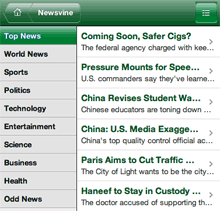 The good fellas’ at Blue Flavor are announcing this morning the release of “Leaflets” — mini browser-based apps for your shiny new iPhone. Available flavors currently include Flickr, Del.icio.us, Upcoming, The New York Times, Newsvine, and a few others.
The cool thing about Leaflets is that they display data from the services listed above in a format tailor made for the iPhone. Apple has made a big deal about how the iPhone can view “the real web” and not “the mobile web”, but while this is true, it still doesn’t mean “the real web” is an ideal format for the iPhone. The mobile savants at Blue Flavor have taken this axiom to heart and created a nice middleware layer which lets me get more out of my Newsvine, my Flickr, and my Del.icio.us by getting less.
Check out iPhone Leaflets at GetLeaflets.com.
Letting go of the Trumpets: A Week with the iPhone
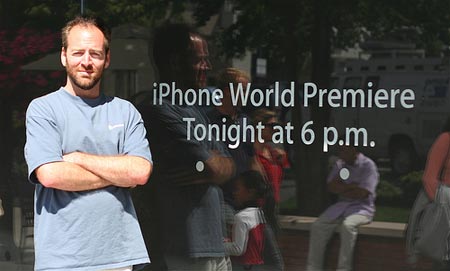
In discussing the iPhone with Dan Benjamin a couple of days ago, at one point I mentioned it was “like someone assembled the finest orchestra the world, but decided to leave out the trumpets”.
Given such an orchestra, one can come away with either of the following reactions:
a) “Wow, what an absolutely fantastic orchestra.”
b) “Uhhh, where are the trumpets?”
With apologies to trumpet players around the world, I find myself decidedly in camp A — sometimes appreciative of what Apple has left out of the iPhone and sometimes frustrated by it, but never losing sight of what a great device this is and what it will become in the months to follow.
A lot has been said already about the jesusphone so who knows how much of this article will be interesting, but it’s a cathartic post for me, having waited several years for this device to become a reality. I first wrote about the iPhone almost exactly three years ago at a time when most of the world thought Apple would never get into the phone business. It’s interesting to see how opinions have changed since then from “why would they ever” to “why would they ever NOT” get into this market.
Read more…