Camino: Supermodel of a Browser?
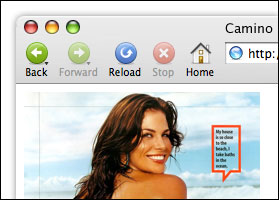 Being a Mac user, I’ve always had a problem with Firefox. I’ve thought long and hard about tasteful analogies for my relationship with it, but I keep coming back to a somewhat shallow one: Firefox is like the girl in school who you knew you should probably date because she’s intelligent, multilingual, and funny, but she just wasn’t very attractive to you.
Safari, on the other hand, has been the opposite: Hot as hell and lives right down the street, but offers little more than instant gratification of primal needs.
Many people who can’t stand to be without both types of relationships have evolved into “browser polygamists”… or, people who use multiple browsers during their normal daily routine. Jon Hicks could be considered the king of the Browser Polygamy movement, hopping from application to application with the recklessness of a late 70s porn star. Jon likes multiple browsers, and he’s not ashamed to admit it.
I, on the other hand, have never liked using multiple apps for any chore, whether it be browsing, e-mail, design, code, or whatever else. I want a single point of entry into whatever I’m doing.
And so it was with great interest that I started playing around with the latest Camino betas a couple of months ago. Camino you say? Wasn’t that a truck that late 70s porn stars drove around in? Nope, that’s the “El Camino“. This is Camino, the web browser; an application I remember using back when it was called “Chimera” in the early OS X days.
Camino is like Firefox with a beautiful makeover. I’m not talking about Lee Press-On Nails and an Ogilvie Home Perm… I’m talking an X-Code workout regimen, a healthy diet of Cocoa, and a Quartz mineral bath. Think of Firefox as Paris Hilton — gets all the press, will compile for anybody, and is a bit strange looking. Think of Camino as younger sister Nicky — much cuter, a bit more refined, and up until now in the shadow of her sister.
Anyway, with today’s announcement of the official 1.0 version, Camino has finally emerged from the shadow of its older sister to become a true contender in the Mac browser space. It looks better than Safari and it feeler faster than Firefox… that’s a great start. Here are some more things I am loving about Camino:
- It’s a snap to import all of your Safari bookmarks.
- The interface is outstanding. Not only is it truly Mac-ish in appearance, but as mentioned above, it’s actually more visually appealing to me than Safari.
- It’s faster than Firefox in all ways, and it seems faster than Safari in certain, but not all occasions. When browsing from page to page within a site (viz. when all JS and CSS are already in cache) you can barely even see the pages repaint. It does seem a tad slower on full page fetches, but as Camino team member Samuel Sidler says, “speed is subjective”.
- Safari’s preferences are limited, but in Camino, almost everything is configurable. Apple’s decision to keep Safari simple isn’t a bad one, as most casual Mac users don’t want to see 1000 options in front of their faces (see: Adium… which I love, by the way), but it is really nice to have a good, highly configurable browser to use again.
- A more comprehensive History display.
- It supports all of the same WYSIWYG web editors that every other browser besides Safari does. Incidentally, this is really my only major beef with Safari from an internals perspective as this point. But it’s a huge beef.
- Everything Hicksy says here and Om says here.
What don’t I like about Camino? Well, really only three things:
- The seemingly slight lag in full-page fetches (although I could be imagining this).
- The lack of a Javascript debugger and other extensions.
- No native spellchecking.
So with that, I will now be trying out Camino as my primary browser for the next month or so. If you’re lookin’ for a change, I recommend you do the same.
Note: Observant readers may notice that I first compare Firefox to a smart woman and then to Paris Hilton. Two separate analogies. Try not to confuse them.