Visualizing Newsvine with Google Maps
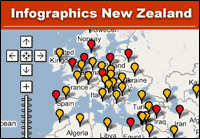 One of the really great things about having such a cool group of early Newsvine users is that people think of great new stuff every day. About an hour ago, Fraser Mills posted an item on Newsvine pointing to a great news visualization he just built with Newsvine data and the Google Maps API. I’d call it a “mashup” but that term has always made me think of pureed food, so I stay away from it.
There are three things in particular that I think are cool here:
- Fraser is building things off our API before our API is even officially released or documented. That is awesome and it’s a testament to the power and flexibility of tagging and XML data. I remember that people started building Peppers for Mint long before The Wolf documented his API as well. I think that’s just great and I encourage anyone who is interested in Newsvine APIs to post their requests to the official Newsvine Blog.
- Aside from freeform location tagging, we actually have 225 regions around the world which we haven’t exposed to users yet. Once true location data like this makes its way into posts, wire articles, and seeds, the map will be even more useful. You’ll be able to zoom in on Seattle, for instance, and get stories down to the micro-local level.
- It’s good to get a look at how Google Maps potentially displays news items. I’m very curious as to how Yahoo Maps compares, because as a designer, I like the Yahoo Maps skinning capabilities a lot more. Justin Everett-Church’s example of Yahoo Maps piped into Flash and set against a pirate theme is an example of what I’m talking about. We place a high premium on everything looking great and I’m wondering what some of the tradeoffs between the two mapping APIs are.
UPDATE: Alright, I guess Yahoo only maps the U.S., so Google it is! And no, we weren’t *really* thinking about a pirate-themed news map. :)
Enjoy this? Subscribe to Mike Industries updates via email, or follow me on Bluesky @mikeindustries.com.
Lookin’ good!
We just announced tagging in our system – makes perfect sense to me (tagging allows us to make show insertion and consumption easier over time).
I’m really excited about a byproduct of the tagging: if venue X has 100 shows in our system, with tags we can look back to see a lot of information about those shows – genre most importantly. Match (mash?) that up with other data, like our zipcode/population/ album sales / mp3 sales (having partner companies == good), and we then have valuable market data we can share w/ bands looking for interesting places to play.
Further (can you tell I’m really excited?), by allowing tagging and different information to float back out of our system, we’ll be making the insertion process easier – once a few people tag a band/artist, we’ll have a good idea of what type of music they are – and can keep live updates (by majority) on where to put those bands on display.
Interesting times, indeed.
That example is really fun…but…
Does that address usability issues? I mean, it’s great fun to play with and it’s great to know that we *can* do such things. But how usable is something like that?
I don’t want to take away from anyone here. I just want to point out that all of these great new uses of internet technology remind me of the late-90s/early-00s web. Lots of eye candy and no thought as to how people are actually going to use these things.
Man, either some people have way too much time on their hands, or they’re really lookin’ for a job at Newsvine ;)
It seems like every other week a new API is being released and these mashups are being formed. Someone should eventually build the ultimate mashup that combines something to do with maps, travel, cooking, photos, and (add random API here).
Chris,
While I would agree with you that there’s a lot of eye candy (how many gradients can we get?), I’d have to disagree that there’s no attention to how people will use the Web.
I think that’s the difference with the Web development nowadays: Those of us that have been through the first few rounds of ups-and-downs, we have finally emerged to an age where owners, managers, partners, and clients now hear our chants of “but will they use it? CAN they use it?”
Sure, I think there’s a bit much of the 2.0. discussion going on, but there was too much blogging going on too … livejournal and more… long before there was a name for it.
Finally, if we don’t build it, how will we ever learn what will be used? Shouldn’t usability be determined by people attempting use?
Please don’t use Yahoo, at least not for now, since they only provide maps for the US. Google’s maps cover the whole planet.
Svante: Ok, well that settles that then! Didn’t know about the U.S.-only aspect. Thanks.
I’ve read some of your posts on newsvine.com and it sounds interesting. What does one have to do to become priviledged?! :)
I’d appreciate some tips at dinescumiky (at) hotmail.com
Oh no… Google covers the world with maps. So many things were wrong with that statement.
The more I hear about Newsvine, the more I want in! Their buzz campaign is working perfectly on me. I’ve registered my interest with them, but unfortunately I don’t know anybody who can provide me with an invite. So I’m waiting for the day they open their site up – I’m really looking forward to seeing it.
Coolies, one of I the reaons I don’t use NewsVine that much yet as it isnt very UK centric.
I’d always wondered about the limited geographic areas, mike… good to know it’ll expand.
I still love how the US stories all point to somewhere in West Virginia… very volatile place, it would seem.
I’m working on my thesis… only in the brainstorming stage right now, but I really want to use geocoding to do some sort of content analysis. Right now, I’m trying to figure out a method for tagging local news. Does anyone know of any studies and/or guidlines that have been used for geocoding news stories? I mean, I want to know how you code a story – by the location of the story (what if there are multiple locations?) by the sources?
Hope this isn’t taken as useless information, but, “Google Maps is the best. True that. Double true!”
Lazy Sunday, the source of the quote.
So super cool. I dig it.
Here’s the thing with visualizations though. Would people use it? I’ve thought about this for TailRank. I’d totally expose the data and allow someone else to do it themselves but I’m not really sure it’s a real world and useful app fro everyday people.
I mean if you want stories on SF you could just view the ‘sanfrancisco’ tag right?
Kevin
Yeah, you could just view the sanfran tag, but what if you wanted to narrow it down even further, say to a specific neighborhood in sanfran?
Kevin: Yep, if it’s just an unweighted map of stories from around the world, that in and of itself is not too useful. But think about it like this:
1. What if it were more of a “heat map” whereby highly ranked/commented/voted-on stories were visually distinct from the rest? Then you could glance at the world, your country, or your state and find out quickly “where the action is”. A bomb went off in some corner of the world you don’t pay attention to? The cluster of stories around that area would ideally be called out for you to see and visually differentiated from the rest of the run-of-the-mill news.
2. What if you lived in a small neighborhood of a big city and you wanted to see, say, all of the breaking real-estate news in areas which you may be considering moving to?
Information can always be had in different ways, and maps usually *aren’t* the best way… but given enough filtration and display options, you can present something pretty interesting. The best example of this is Adrian Holovaty’s chicagocrime.org site. Want to see all of the mugging crimes committed on your block recently? Zoom in and filter. And then consider getting the hell out of Chicago… :)
[…] impressively, Davidson has written today that an API is in the works and that: “Once true location data like this makes its way […]